
No single AI LMS wins for every UAE organization. The right choice depends on who you train (external clients, your own workforce, or both) and on the Arabic delivery, data hosting and licensing requirements attached to your programmes.
For professional training companies and client-facing academies, the shortlist starts with Blend-ed. For enterprise workforce skilling, Disprz leads, with Sana Learn as the AI-native option for learning plus knowledge management. Docebo is the usual candidate for customer and partner education at enterprise scale. Moodle Workplace remains the partner-delivered route for organizations that want hosting control, Lumofy is the GCC-native skills and competency platform, and CYPHER Learning is the AI-native multilingual alternative.
This guide compares all seven on AI capabilities, Arabic and RTL support, multi-client delivery, pricing and UAE-specific considerations: training permits, UAE data protection law and where AI features process your data. The order is editorial and reflects relevance to UAE buyers and professional training use cases, not an objective universal score. Blend-ed publishes this comparison; the disclosure and evidence standards are in the evaluation section below.
Which AI LMS fits which UAE buyer
| Buyer type | Strong options | Why |
|---|---|---|
| Professional training companies and client academies | Blend-ed, CYPHER Learning | Multi-client delivery, certificates, e-commerce and bundled AI |
| Enterprise workforce skilling and frontline | Disprz, Sana Learn | Skills frameworks, AI-native learning and capability analytics |
| Customer and partner education at scale | Docebo, CYPHER Learning | Multi-portal extended enterprise delivery with automation |
| Hosting control and deep configuration | Moodle Workplace | Partner-delivered open-source platform, negotiable hosting |
| GCC skills and competency programmes | Lumofy | Bilingual competency mapping and performance-linked learning |
Jump to the detailed reviews: Blend-ed | Disprz | Sana Learn | Docebo | Moodle Workplace | Lumofy | CYPHER Learning
Who this comparison is for
It is written for organizations buying learning platforms in the UAE: professional training companies, commercial academies, continuing education and CME providers, customer and partner education teams, enterprise L&D, and government or regulated organizations. If you issue certificates for training delivered in the UAE, read the verification section first; permits and data requirements can eliminate platforms before features ever matter.
UAE AI LMS comparison table
| Platform | Best for | Arabic and RTL | Multi-client delivery | AI capabilities | Pricing model | Main limitation |
|---|---|---|---|---|---|---|
| Blend-ed | Training companies and client academies | Arabic and RTL listed; multilingual in all plans | Multi-organization delivery | AI Course Creator, AI Tutor, Knowledge Assistant, Admin Agent | Quote-based; plan structure public | No public pricing |
| Disprz | Enterprise workforce skilling | Arabic site; 20+ interface languages; RTL not explicitly documented | Primarily internal audiences | Turo agentic authoring, skills intelligence, AI roleplay coach | Public entry price, USD 3 per learner/month | Not built for commercial academies |
| Sana Learn | AI-native enterprise learning | AI translation incl. Arabic; platform RTL not confirmed | Multi-tenancy documented | Doc-to-course generation, AI assistant, admin autopilot | Quote-based; 300-user minimum | No published UAE presence; now part of Workday |
| Docebo | Enterprise and extended enterprise | 59 languages incl. Arabic; RTL orientation documented | Multi-portal extended enterprise | AI Creator, Harmony assistant, AI search | Quote-based; active-user models | No Middle East hosting region on its own sub-processor list |
| Moodle Workplace | Institutional control via partners | Mature Arabic packs and RTL | Multi-tenant architecture | Bring-your-own AI provider; off by default | Partner quotes; no license price | You or your partner own AI assembly |
| Lumofy | GCC skills and competency | Bilingual EN/AR interface in all plans; RTL wording not published | Not publicly documented | Competency, performance, assessment and talent agents | Quote-based; ~50-user minimum | Not a full commercial LMS |
| CYPHER Learning | Multilingual AI course creation | Arabic among 50+ languages; RTL not stated | Multi-tenant white-label portals | Course generation from files, AI Crosscheck, learner agent | Quote-based; two tiers | No UAE case studies or named regional hosting |
Statuses reflect public documentation checked on 9 July 2026; sources appear in each review.
Run a training business? Check whether Blend-ed matches your delivery model before you book any demos.
Compare Blend-ed with your shortlist
How we evaluated these platforms
Blend-ed publishes this comparison. Claims were checked against official vendor documentation, and anything we could not confirm is labeled that way; the same standard applies to Blend-ed. The labels used throughout: official vendor documentation, directly confirmed by the vendor, third-party reported, and not publicly confirmed.
To qualify, a platform needed vendor-documented AI functionality (or an official AI framework) that affects course creation, learner support, administration, analytics or skills development. Platforms were then assessed on UAE relevance, fit for professional and external training, Arabic and RTL support, multi-client delivery, certificates and ILT, e-commerce, hosting and data governance, integrations and security, pricing transparency, and implementation evidence in the region.
We did not assign scores or weights; public evidence does not support that precision. The numbered order is editorial: professional and external training relevance leads, and platforms with stronger documented Arabic delivery rank above those without it within each group. No structured hands-on test across all seven has been completed, pricing changes without notice, and vendor documentation can lag product reality in both directions.
What should UAE buyers verify before choosing an AI LMS?
Three things decide more UAE deals than any feature list: whether your training needs a permit, where learner data lives, and where the AI processes your content. This is procurement guidance, not legal advice; confirm your obligations with qualified advisers.
Do you need approval to deliver training in the UAE?
Training oversight in the UAE runs at emirate level. Private training institutes in Dubai operate under KHDA permits, and vocational and technical training in Abu Dhabi is licensed through ACTVET. Free zones apply their own authority rules, and other emirates have their own education departments. Which approvals you need depends on your emirate, legal setup and programme type, so confirm your path with the relevant authority before you commit to a platform. Unlike some neighbouring markets, there is no UAE-wide mandate to integrate your LMS with a national e-learning platform; the practical gates are your permit, your data locations and any sector rules.
Does UAE law require learner data to stay in the country?
Not universally. The UAE’s federal Personal Data Protection Law (Federal Decree-Law No. 45 of 2021) regulates how personal data is collected, processed and transferred, and the UAE government’s data protection overview also lists the separate regimes that apply in financial free zones (DIFC and ADGM) and to health data. Cross-border transfers are regulated rather than banned, but government contracts, health-sector rules and free-zone regimes can impose stricter localization than the federal law. The practical move: ask each vendor to name the cloud regions used for production data, backups, logs, disaster recovery and AI processing, and require those locations in the contract.
Two research findings sharpen this for the UAE. Docebo’s own sub-processor list offers hosting in the USA, EU, UK, Canada, India and Australia, with no Middle East region. CYPHER Learning names data centers in the USA, Germany and Australia on its FAQ. If in-region hosting matters to you, ask early; it is a differentiator few vendors document.
Where does the AI process your data?
AI features move data in ways standard LMS due diligence misses. For every shortlisted platform, ask where these are stored and processed: AI prompts, uploaded source documents, AI tutor conversations, generated content, assessments, embeddings, logs and anything held by AI subprocessors. Then get two answers in writing: is customer data used to train shared models, and how is that disabled? A vendor that cannot answer in writing is a risk you should price in.
Which sector rules change the shortlist?
Government entities, banks, healthcare providers and other regulated organizations can face requirements beyond the federal data law, including contractual UAE-hosting clauses, identity and audit controls, and sector regulators’ cybersecurity frameworks. Not every framework applies to every buyer; map yours before shortlisting, because a hosting requirement can remove half the market in one line.
How much does an AI LMS really cost in the UAE?
The subscription is only part of it. Watch six things: whether pricing counts active or registered users, annual minimums, implementation and migration fees, AI add-ons or usage credits, costs for mobile apps, white-labeling, storage and premium support, and exit terms including data export.
Public pricing, where it exists (checked 9 July 2026; recheck official pricing pages before relying on them):
| Platform | Public starting price | Notes |
|---|---|---|
| Disprz | USD 3 per learner per month (Essentials) | Scales with active learners; Enterprise is custom; several capabilities are add-ons priced by sales |
| Moodle Workplace | No public price | Sold through Premium Certified Partners; total cost sits in hosting, services, integrations and AI provider fees |
| All others in this list | Custom quote; no public starting price when checked | Blend-ed (plan structure public, amounts not), Sana Learn (300-user minimum), Docebo (250+ learners recommended), Lumofy, CYPHER Learning |
The 7 best AI LMS platforms in the UAE for 2026
Platform 1 is built for professional and external training. Platforms 2 to 4 serve enterprise workforce and extended enterprise learning. Platform 5 is the partner-delivered open-source route, and platforms 6 and 7 are the GCC-native and multilingual AI alternatives. These categories solve different problems; do not treat them as interchangeable.
One finding applies across the list: as of 9 July 2026 we did not find a publicly documented UAE data-residency commitment for any SaaS platform here. Use the hosting and AI-processing questions above with every vendor.
1. Blend-ed
Best for
professional training companies, client-facing academies, and continuing education, CME and compliance training providers running certified programmes for external clients.
Overview
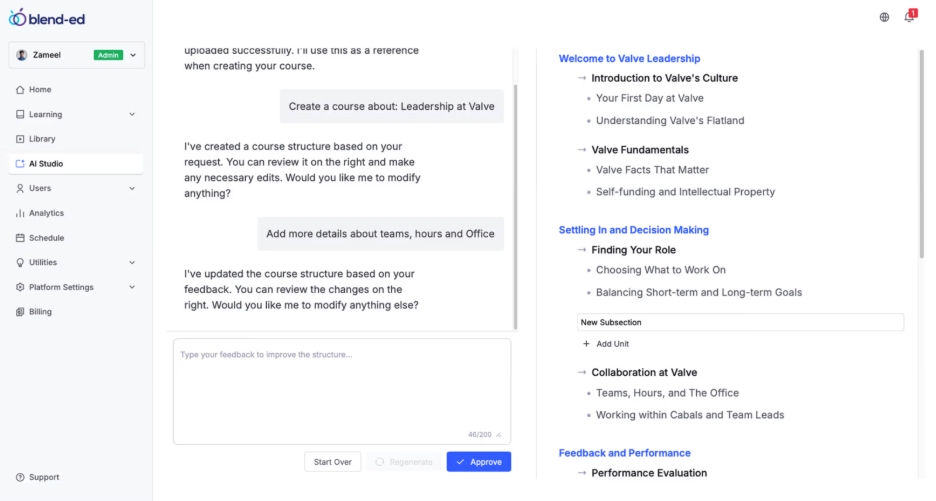
Blend-ed is an AI-first learning platform built on Open edX for organizations that deliver training as a business. It combines course delivery, cohorts, certificates and e-commerce with a bundled agentic AI suite (AI Course Creator, AI Tutor, Knowledge Assistant, Admin Agent), plus multi-organization delivery for serving separate clients from one system.
Why it fits UAE buyers
Arabic and RTL are listed platform capabilities alongside multilingual delivery and mobile access (official vendor documentation). Training providers like Risknowlogy run functional safety certification programmes (IEC 61508, SIL) on it, and Health on Cloud delivers CME, the same delivery pattern UAE training companies and client academies run. Deployment architecture is scoped per project, so apply the standard proof request: cloud regions for production data, backups, logs and AI processing, named in the contract.
Key capabilities
- Cohort-based, instructor-led, self-paced and blended delivery with certificates and structured client programmes
- AI Course Creator drafts courses from prompts and existing documents, with the AI Tutor and admin automation included in both plans; drafts are edited and published in the Open edX authoring environment, so ask for an export-format demonstration if portability matters
- Multi-organization delivery for client-separated training (see the multi-tenant LMS guide), with SCORM, LTI and H5P content support
- E-commerce with payment gateway integration and unlimited registered users on the Core plan
Pricing
quote-based across Core and Enterprise tiers; the plan structure is public on the pricing page but amounts are not (official vendor documentation). Core includes the full AI suite and unlimited registered users; native iOS and Android apps, SSO and API access sit on Enterprise. A 7-day free trial is available with no card required.
Pros
- Delivery model matches how training businesses run: multiple clients, cohorts, certificates and paid programmes
- AI suite bundled in both tiers rather than licensed separately
- Unlimited registered users at entry level suits academies with large learner pools
Limitations
- No public pricing; budgeting requires a quote
- Native mobile apps, SSO and APIs require the Enterprise tier
- More platform than simple internal course hosting needs
Verdict
our editorial recommendation for UAE organizations delivering certified training to external clients or cohorts. Choose it when multi-client operations, certificates and bundled AI matter together; skip it if you only need to host a few static internal courses.
Sources checked
product page, pricing and feature table.
2. Disprz
Best for
enterprises building measurable workforce skills across frontline and knowledge workers.
Overview
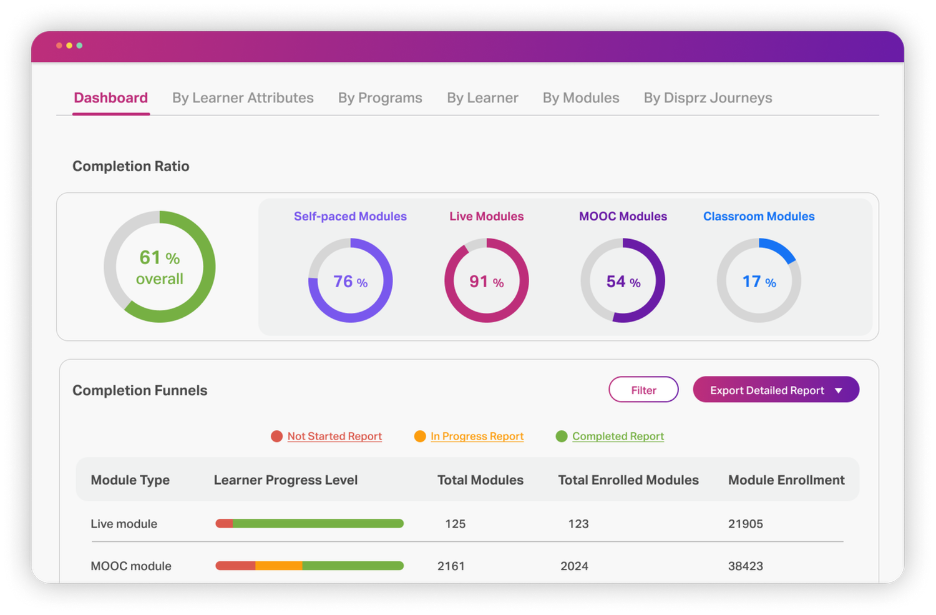
Disprz combines LMS, LXP and skills intelligence with mobile-first delivery. Turo, its agentic authoring layer, generates learning in six-plus formats with a quality agent reviewing output, and role-linked skill frameworks connect learning to capability (official vendor documentation).
Why it fits UAE buyers
Disprz lists its Middle East regional HQ in Dubai on its company page and publishes UAE case studies, including Al Shirawi Group unifying learning across 15 companies. It also runs a full Arabic version of its website and claims 20+ interface languages with auto-translation. Platform-level Arabic UI and RTL behavior are not explicitly documented, so include admin screens in the Arabic demonstration.
Key capabilities
- Turo agentic authoring: videos, simulations, quizzes and assessments generated from your content, in 12+ languages with cultural adaptation
- Skills taxonomies, role mapping and gap analytics tied to business outcomes
- Mobile-first frontline enablement with QR-based ILT attendance
- SSO (SAML 2.0, OAuth 2.0), HRIS connectors; ISO 27001:2022, SOC 2 and GDPR listed (official vendor documentation)
Pricing
the only top-7 platform with a public entry price: Essentials from USD 3 per learner per month, scaling with active learners; Enterprise is custom and several capabilities are add-ons.
Pros
- Verified Dubai regional HQ and named UAE and GCC customers
- Published entry pricing, rare in this list
- Skills-first architecture rather than completion tracking
Limitations
- Not designed for commercial academies or client-separated external training; multi-tenant white-label terms are not publicly documented
- RTL and platform Arabic depth need demonstration
- UAE data residency is not publicly stated despite the regional presence
Verdict
worth shortlisting when the goal is internal workforce capability at enterprise scale in the UAE. Avoid it when you sell certified training to external clients; that is a different operating model.
Sources checked
pricing, company page, Turo, platform security and languages.
3. Sana Learn
Best for
knowledge-worker enterprises that want AI-native learning and knowledge management in one system.
Overview
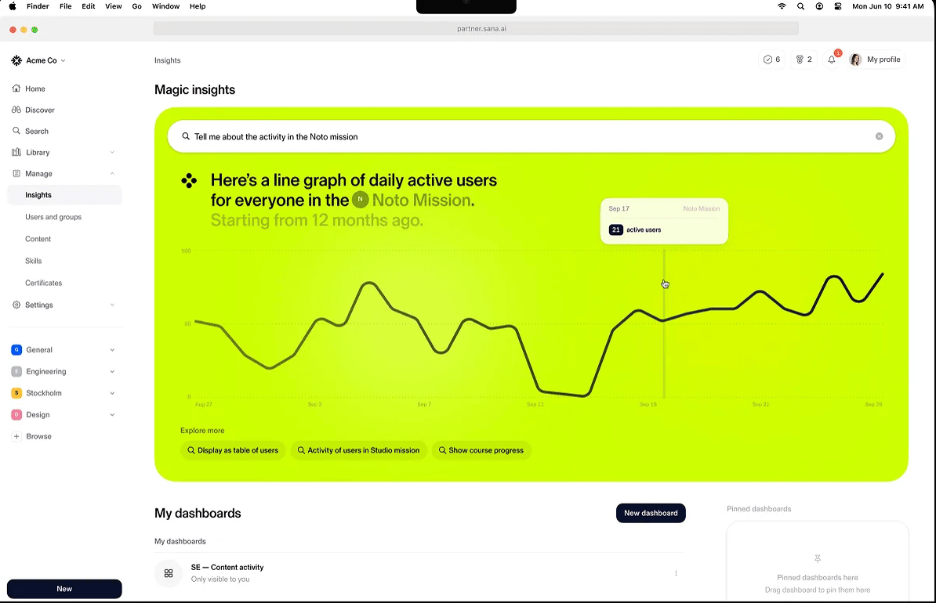
Sana Learn combines an LMS, LXP, authoring tool and virtual classroom. Upload a document and it drafts structure, content and quiz questions; learners get an AI assistant that answers from approved company content with sources cited; enrollments and renewals run on rules (official vendor documentation).
Why it fits UAE buyers, with caveats
course content translates into Arabic through AI translation (help documentation lists Arabic among supported translation languages), and the platform interface covers 63 languages. RTL layout is not publicly confirmed, Sana publishes no UAE office or customers, and its closest regional reference is Unifonic in Saudi Arabia. One corporate fact every 2026 buyer should weigh: Workday completed its acquisition of Sana in November 2025; Sana Learn still sells standalone, and the roadmap now includes deeper Workday integration. Ask how that affects non-Workday customers before signing long term.
Key capabilities
- AI course generation from uploaded documents, with AI-generated assessments
- AI assistant with tutor mode answering from approved content, sources cited
- Admin autopilot for rule-based enrollments and compliance renewals; certificates with expiry handling
- Multi-tenancy with full branding customization for external training (official vendor documentation)
Pricing
quote-based per user per month, with plans starting at 300 users; implementation is included and no capabilities sit behind add-ons (official vendor documentation).
Pros
- Deep AI-native capability across authoring, learner support and admin automation
- Documented multi-tenancy and branding for external audiences
- ISO 27001:2022 and SOC 2 Type II published on its trust center
Limitations
- 300-user minimum excludes smaller training providers
- No documented learner mobile app; RTL and UAE presence unconfirmed
- Post-acquisition roadmap is Workday-centric
Verdict
worth shortlisting for 300+ user enterprises consolidating learning and knowledge on one AI-native platform. Avoid it for mobile-first frontline delivery or small academy operations.
Sources checked
Sana Learn product page, pricing, external training solution, trust center, Workday acquisition release.
4. Docebo
Best for
enterprises automating large learning operations across internal, customer and partner audiences.
Overview
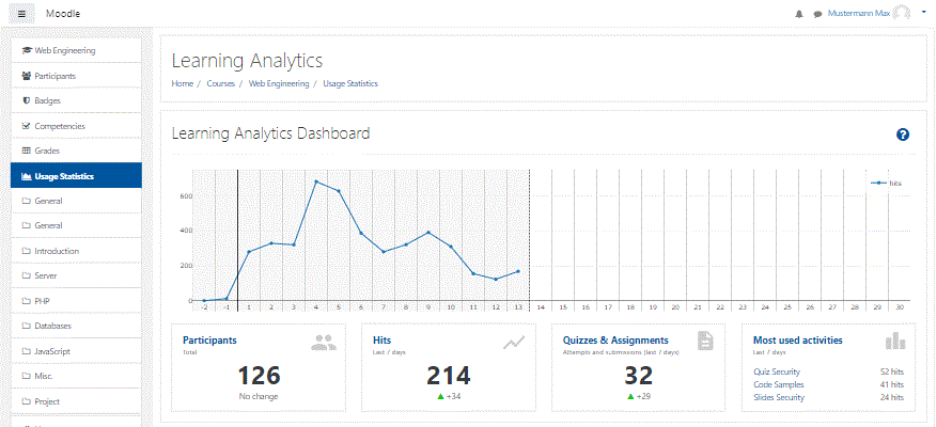
Docebo is an enterprise learning platform with AI-driven content generation, discovery and workflow automation, multi-portal extended enterprise delivery with e-commerce, and a 400+ integration ecosystem (official vendor documentation).
Why it fits UAE buyers
Docebo lists a Dubai office on its contact page and has the strongest documented localization in this list: 59 platform languages including Arabic, with an explicit right-to-left orientation setting in its localization tool (official vendor documentation). Test AI features separately: its own AI FAQ states virtual coaching works in English only and auto-tagging covers six European languages, not Arabic. Hosting is the gap; its sub-processor list names no Middle East region, so UAE data sits abroad.
Key capabilities
- AI Creator for lesson and assessment generation, Harmony assistant, AI-powered search
- Extended enterprise: multi-portal branded delivery with e-commerce
- Certifications and retraining automation, audit trails, 21 CFR Part 11 support
- Go.Learn mobile app with offline mode and a branded app option
Pricing
quote-based on active-user models (monthly, yearly or registered active users), recommended for 250+ learners, with multi-year contracts typical and paid onboarding programmes running 8 to 20 weeks (official vendor documentation). AgentHub, its no-code AI agent builder announced in April 2026, is listed as coming in fall 2026; do not buy on that promise yet.
Pros
- Enterprise maturity across automation, integrations and compliance
- Documented Arabic interface and RTL orientation, rare in this list
- Dubai office for regional engagement
Limitations
- No Middle East hosting region on its own sub-processor list
- Arabic is missing from parts of the AI lineup
- Cost, contract length and implementation weight exceed smaller teams’ needs
Verdict
worth shortlisting for enterprise-scale customer, partner and compliance learning run from the UAE, provided Arabic AI coverage and hosting pass your acceptance tests. Too heavy for small and mid-size training companies.
Sources checked
supported languages, localization and RTL setting, AI FAQ, pricing, sub-processor list, contact page.
5. Moodle Workplace
Best for
organizations that want hosting control, deep configuration and an open-source foundation, delivered through a certified partner.
Overview
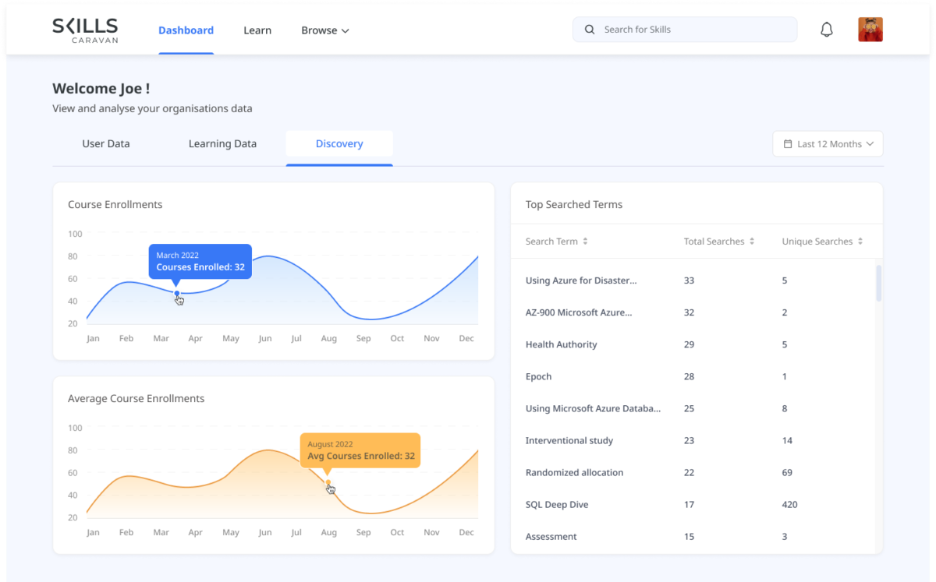
Moodle Workplace is the enterprise edition of the most widely deployed open-source LMS, sold and hosted exclusively through Moodle Premium Certified Partners. It adds multi-tenancy, organization structures, programs, certifications with recertification, dynamic rules and a custom report builder on top of Moodle LMS (official vendor documentation).
Why it fits UAE buyers
there is a verified local route to buy: Human Logic, a Dubai-based Premium Certified Partner with clients including ADNOC and Oman LNG. Arabic language packs and RTL theming are mature in Moodle. Hosting is negotiable with the partner, including regional arrangements, which makes it a frequent finalist for government and regulated buyers.
Key capabilities
- Multi-tenancy: each division, client or entity gets its own branded environment
- Programs and certifications with automated recertification for compliance cycles
- Dynamic rules automating enrollment and competency assignment
- Branded mobile app with offline learning, delivered as a partner service
Pricing
no public pricing; cost is the partner’s hosting and services quote. Do not confuse it with MoodleCloud, a separate product that does not run Workplace.
Pros
- Maximum control over data location, architecture and cost allocation
- Mature Arabic and RTL support
- Multi-tenant and certification depth without per-portal SaaS fees
Limitations
- The AI subsystem (Moodle 4.5 onward) ships with no provider connected; text and image generation only work after you or your partner configure OpenAI, Azure, Ollama or another provider, and there is no native AI tutor or admin agent
- You own assembly, governance and maintenance, or pay a partner to
- Total cost of ownership is routinely underestimated
Verdict
choose Moodle Workplace when hosting control or procurement rules lead the decision and you have real technical ownership or a strong UAE partner. Avoid it if you expect AI to work out of the box. For how the underlying platforms compare, see Open edX vs Moodle.
Sources checked
Workplace product page, Workplace features, AI subsystem documentation, Human Logic partner page.
6. Lumofy
Best for
GCC organizations building internal capability through competencies, assessments and performance-linked learning.
Overview
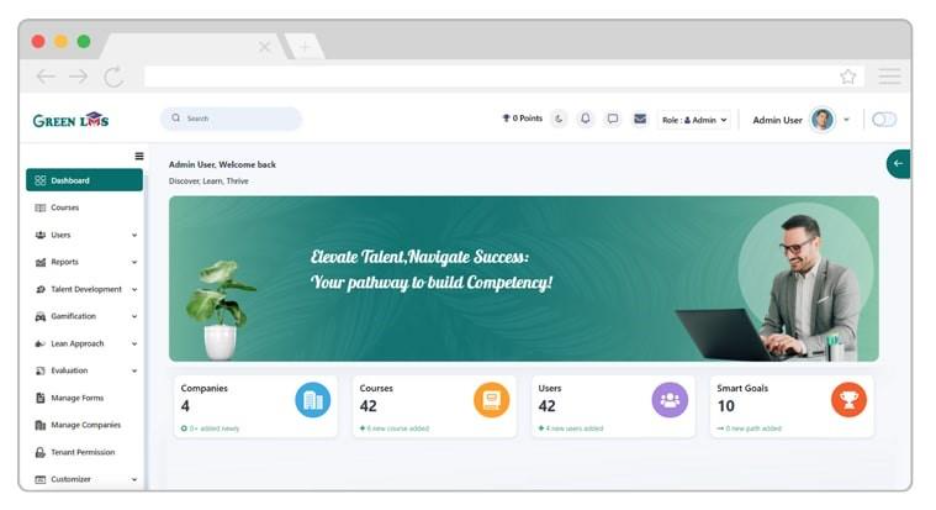
Lumofy is a GCC-native performance and skills development suite with a learning module. Its AI agents generate competency frameworks, draft performance goals and KPIs, build skills-based assessments and map high-potential talent; the learning module covers authoring, learning paths, a 1,600+ course catalog, gamification and automatic certificates (official vendor documentation).
Why it fits UAE buyers
it is one of the few regional options with a bilingual English and Arabic interface included in every plan, Arabic help documentation, and offices in Manama and Riyadh. Its client roster is Gulf-heavy (Gulf Air, Tamkeen, Kuwait Finance House, with ADNOC among the logos). There is no UAE office, and the words “RTL support” do not appear in its public documentation, so run the Arabic demonstration anyway.
Key capabilities
- AI agents for competency frameworks, bilingual goal generation and KPIs
- Skills-based assessments and 9-box talent mapping
- Learning module with authoring, paths, catalog and automatic certificates
- ISO 27001 listed in all plans
Pricing
quote-based by module and employee count, with a recommended minimum around 50 users and three implementation tiers (official vendor documentation).
Pros
- GCC-native with bilingual design rather than translated add-ons
- Skills and competency depth most LMS platforms lack
- Accessible entry size for mid-market organizations
Limitations
- Not a full commercial LMS: SCORM, e-commerce, multi-tenant client portals and a public API are not publicly documented
- Android app not publicly evidenced (iOS app is)
- AI course creation from your documents is not clearly stated
Verdict
worth shortlisting when the goal is internal, Arabic-first capability building: competency mapping, assessments and development plans. Avoid it as the delivery platform for a training business.
Sources checked
Lumofy site, pricing and plans, contact and offices.
7. CYPHER Learning
Best for
organizations creating a high volume of multilingual courses that want AI to do the heavy lifting, for internal teams or client portals.
Overview
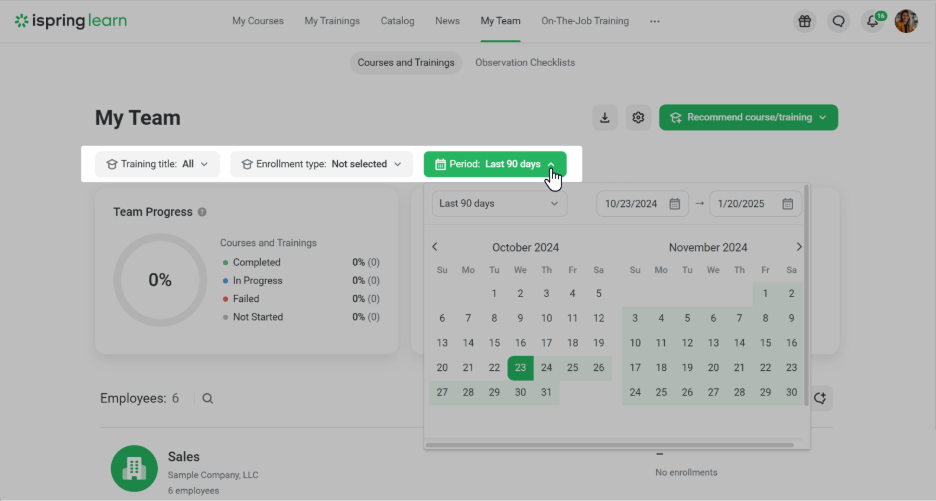
CYPHER Learning is an AI-native platform whose agent builds courses from your uploaded files, generating assessments, gamification and glossaries together, with a claimed average of 5 to 10 minutes per course. AI Crosscheck, a second AI system, flags hallucinations in generated content, and a learner-facing agent tutors, runs practice and assesses conversationally (official vendor documentation).
Why it fits UAE buyers
Arabic is among 50+ interface languages with per-user real-time translation, its e-commerce supports Telr, a UAE-based payment gateway, and complete white-label multi-tenant portals give each client its own domain, branding and analytics. The gaps: no explicit RTL statement, no UAE case studies, Dubai named only in a company FAQ without an address, and named data centers in the USA, Germany and Australia.
Key capabilities
- AI course creation from files, with assessments and gamification generated together
- AI Crosscheck verification of generated content
- Multi-tenant white-label portals with per-portal domains and analytics
- E-commerce with multi-currency support including Telr
Pricing
quote-based across Enhanced and Enterprise plans; its calculator asks for learners, creators and courses per year but publishes no rates (official vendor documentation).
Pros
- Broadest documented AI authoring workflow in this list
- Complete white-labeling suits client-facing delivery
- UAE-relevant payments via Telr
Limitations
- RTL behavior is not publicly documented
- ISO 27001 listed as in progress on its FAQ; SOC 2 Type 2 is certified
- No published UAE presence or regional hosting
Verdict
worth shortlisting when AI course creation volume and multilingual delivery lead your requirements and the Arabic RTL demonstration checks out on your own content.
Sources checked
AI 360, languages, white-label platform, e-commerce, FAQ and security.
Other platforms UAE buyers ask about
TalentLMS and iSpring (renamed iSpring LMS) are solid SMB tools with transparent pricing (TalentLMS from USD 119 per month; iSpring publishes about USD 4.46 per user per month at 300 users) and Arabic among their interface languages, but multi-client and governance depth is limited for the buyers in this guide. Calibr offers strong AI authoring from documents and URLs, with no public pricing and no published Arabic, RTL or UAE evidence. Innovito, with a Sharjah office, pairs AI authoring and an Arabic and English course library with services, though its LMS product documentation is thin. Smart Learning Arabia is Dubai-registered and Arabic-first, selling sector AI workflows for education, government and tourism rather than a documented corporate LMS.
How to test Arabic and RTL support before you sign
“Arabic supported” on a vendor page can mean anything from a fully mirrored experience to a translated learner menu over an English admin console. We found no publicly accessible independent Arabic AI benchmarks for these platforms as of 9 July 2026, so the burden of proof sits in your demo. Make every shortlisted vendor demonstrate, on your own sample content:
- Learner interface in Arabic: menus, buttons, progress elements, player controls
- Administrator interface in Arabic: can admins work in Arabic, or English only?
- Authoring in Arabic: create and edit a lesson, not just display one
- Mixed Arabic and English in one paragraph: numerals, dates, punctuation, alignment
- Mobile RTL rendering and navigation on iOS and Android
- Certificates with Arabic names and correct layout
- Notifications and emails rendering RTL in real inboxes
- Arabic search returning your Arabic content
- Reports with Arabic field values and clean exports
- AI course generation in Arabic, reviewed by a native speaker for grammar, register and hallucinations
- AI tutor answers in Arabic, checked against your course content
- Screen-reader behavior with RTL layouts
Use the same prompt and source document with every vendor so outputs are comparable. A reusable benchmark: ask each vendor to generate a 30-minute Arabic workplace safety induction for a UAE distribution company, with three learning objectives, one scenario assessment, a five-question quiz, an English translation and a completion certificate, then have a native speaker score the results against this list. This article makes no tested claims about any platform’s Arabic AI output.
Which AI LMS should you choose in the UAE?
- Professional training companies and client academies: Blend-ed is our editorial recommendation; CYPHER Learning when AI authoring volume defines the model; Docebo at global enterprise scale. See also the broader guide to the best LMS for training companies
- Enterprise workforce skilling: Disprz for skills-led development; Sana Learn for AI-native learning plus knowledge management
- Customer and partner education: Docebo, with Blend-ed as the alternative when certified client training run by a training business is the model; more options in our external training provider comparison
- GCC competency and performance programmes: Lumofy, often alongside a delivery LMS rather than instead of one
- Government and regulated organizations: shortlist on hosting and audit requirements first; Moodle Workplace through a UAE partner and vendors that contract regional hosting are the usual finalists
- Open-source deployments: Moodle Workplace via a Premium Certified Partner
Who should not choose Blend-ed
Honest qualification saves everyone time. Blend-ed is probably not your platform if you only need basic internal course hosting for a small team, want learning fully embedded in an existing HR suite, want a completely self-managed open-source stack, or do not need multi-client delivery, AI-assisted creation, certificates, cohorts or structured programmes. A simpler or more specialized tool will serve you better in those cases.
UAE AI LMS procurement checklist
Copy these into your RFP or demo script. Each is phrased to produce evidence, not a yes:
- State which approvals our programmes need in our emirate or free zone, and from which authority.
- Name the cloud regions used for production data, backups, logs, disaster recovery and AI processing, and include them in the contract. State any UAE or GCC hosting options and their cost.
- State the legal basis and safeguards you rely on for cross-border transfers under UAE data protection law.
- List where AI prompts, uploaded documents and AI tutor conversations are processed, and name the AI subprocessors.
- Confirm in writing whether customer data trains shared AI models and how we disable it.
- Show how AI-generated content and AI tutor interactions are logged, and export the audit trail.
- Demonstrate the learner, administrator, authoring, reporting, certificate and mobile interfaces in Arabic using our sample content.
- Generate a course in Arabic live, and let our native speaker review it.
- Demonstrate how client organizations are separated, and price each additional portal, tenant or academy.
- Walk through certificate issuance, branding, verification and audit.
- Run an instructor-led session end to end at our volumes: scheduling, attendance, completion.
- Show e-commerce checkout with AED pricing and UAE VAT handling.
- State how pricing counts users (registered, active or monthly active) and what happens in low seasons.
- Itemize what implementation includes, and everything it excludes.
- State the contract minimum, renewal increase policy and support coverage in Gulf Standard Time.
- Demonstrate a full data export: formats, scope, cost and timeline at exit.
Frequently asked questions
What is the best AI LMS in the UAE?
It depends on your delivery model. Blend-ed leads for professional training companies and client academies; Disprz and Sana Learn for enterprise workforce learning; Docebo for customer and partner education at scale; Moodle Workplace for partner-delivered hosting control; Lumofy for GCC competency programmes; CYPHER Learning for multilingual AI course creation.
Which AI LMS is best for professional training companies in the UAE?
Blend-ed is our editorial recommendation: multi-client delivery, cohorts, certificates, e-commerce and a bundled AI suite (AI Course Creator, AI Tutor, Admin Agent), with unlimited registered users on its entry plan. CYPHER Learning suits providers whose model centers on high-volume AI course creation; Docebo suits enterprise-scale extended enterprise programmes.
Do training providers need approval to operate in the UAE?
Training oversight is emirate-level. Private training institutes in Dubai operate under KHDA permits, vocational training in Abu Dhabi is licensed through ACTVET, and free zones apply their own rules. Requirements depend on your emirate, legal setup and programme type, so confirm your path with the relevant authority before committing to a platform.
Does UAE data protection law require learner data to stay in the UAE?
Not universally. The federal Personal Data Protection Law (Federal Decree-Law No. 45 of 2021) regulates cross-border transfers rather than banning them, while DIFC, ADGM, health-sector and government rules can impose stricter localization. Ask each vendor to name the cloud regions for production data, backups and AI processing, and put them in the contract.
How much does an AI LMS cost in the UAE?
Disprz publishes the only top-7 entry price, USD 3 per learner per month. Blend-ed, Sana Learn (300-user minimum), Docebo (250+ learners recommended), Moodle Workplace (partner quotes), Lumofy and CYPHER Learning are quote-based. The dirham’s AED 3.6725 peg makes USD pricing predictable; the real variance sits in user definitions, AI add-ons, implementation and Arabic configuration, so request itemized quotes on identical scenarios.
Which AI LMS supports Arabic and RTL?
Docebo documents Arabic among 59 languages plus an RTL orientation setting, and Moodle’s Arabic packs and RTL theming are mature. Blend-ed lists Arabic and RTL as platform capabilities. Lumofy ships a bilingual English and Arabic interface. Disprz, Sana Learn and CYPHER Learning document Arabic language or translation support without an explicit RTL statement. Whatever the documentation says, run the structured Arabic demonstration before contracting.
Which platform is best for customer and partner education?
Docebo is the strongest documented extended enterprise option in this list, with multi-portal delivery and e-commerce. CYPHER Learning is the white-label alternative with AI-led authoring. Blend-ed fits when the model is certified client training run by a training business rather than product education run by a software company.
Is an AI LMS different from a normal LMS?
Yes, when the AI does real work: creating courses from your documents, tutoring learners from approved content, generating assessments, automating admin and surfacing skill gaps. Many platforms use the label with far less behind it, so ask what the AI actually does in your workflow and where it processes your data.
Shortlist well
Pick the two or three platforms from the category that matches your delivery model, run the Arabic demonstration and the procurement checklist above, and request itemized quotes on identical scenarios. That process, more than any ranking, prevents the expensive mistake. For evaluation structure, see our AI LMS buyer guide; for the market beyond the Emirates, our comparison of AI LMS platforms globally.
Discuss your learner volume, client structure and UAE deployment requirements.