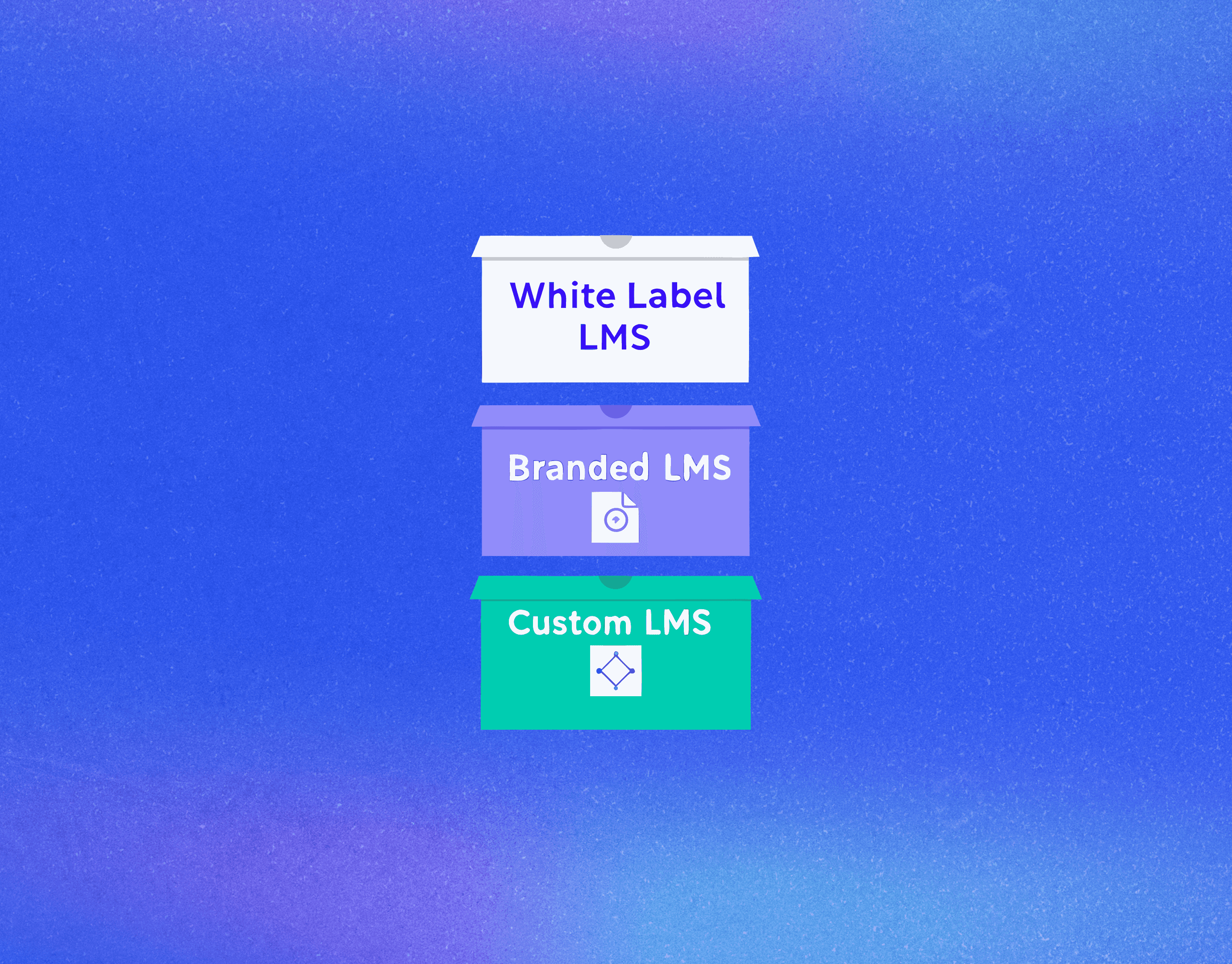

Three terms get used as if they mean the same thing: white label, branded, and custom LMS. They do not. The difference between them is the difference between a few hundred dollars a month and a few hundred thousand dollars upfront. It is also a difference between launching this week and launching next year.
Most buyers pick the wrong one because the words blur together on every vendor's website. They pay for a custom build they never needed, or they settle for a branded skin when they needed full ownership of the experience. This guide separates the three clearly, so you can match the right model to your business and your budget.
What is the difference between a white label, branded, and custom LMS?
A branded LMS is an off-the-shelf platform with your logo and colors added, but the vendor's name still shows through. A white label LMS is a pre-built platform you rebrand completely, with no vendor trace anywhere. A custom LMS is built from scratch for your exact needs, and you own the code.
The table below compares the three factors that decide the choice.
| Attribute | Branded LMS | White Label LMS | Custom LMS |
|---|---|---|---|
| Branding depth | Logo and colors only | Every surface, no vendor trace | Total, by design |
| Vendor visibility | Visible in domain and emails | Invisible | None, the platform is yours |
| Time to launch | Days | Days to weeks | 6 to 18 months |
| Upfront cost | Low | Mid | $150,000 to $400,000+ |
| Ongoing cost | Subscription | Subscription | $30,000 to $60,000 a year to maintain |
| Technical skill needed | None | Low | High, needs a dev team |
| Code ownership | No | No | Yes |
| Data control | Vendor-hosted | Vendor-hosted | You control |
| Best for | Small internal teams | Training companies and course sellers | Enterprises with unique workflows and budget |
What is a branded LMS?
A branded LMS is a standard platform that lets you add your logo, change the colors, and sometimes edit the login page. It is the lightest form of customization. Setup takes minutes and costs the least of the three.
The catch is that the vendor still shows through. Your portal often sits on an address like yourcompany.vendorname.com. System emails come from the vendor's domain. The mobile app, if there is one, carries the vendor's name. Learners can see who really built the platform.
A branded LMS suits a small internal team that trains a few hundred staff and does not mind the vendor showing through. It does not suit anyone selling training or running portals for clients.
What is a white label LMS?
A white label LMS is a pre-built platform you rebrand from top to bottom. Your domain, your colors, your emails, your certificates, your mobile app. The vendor disappears. Learners experience the platform as yours.
This is the difference that trips buyers up. A branded LMS changes the surface. A white label LMS removes every vendor fingerprint, including the ones buyers forget to check, like password reset emails and the App Store developer name. If you want a structured way to test for this, see our guide on how to choose a white label LMS.
You do not own the code, and the platform runs on the vendor's infrastructure. What you own is the brand and the learner relationship. For most training companies, that is the right trade. You launch in days to weeks, not months, and you keep full control of how your brand shows up.
What is a custom LMS?
A custom LMS is built from scratch for your exact requirements. You decide every feature, every screen, every integration. You own the code, and you control where the data lives.
That control is expensive. Industry estimates put a full custom build at $150,000 to $400,000 upfront, with another $30,000 to $60,000 a year to maintain, and a timeline of 6 to 18 months before launch (Of Ash and Fire). You also carry the work of fixing bugs, shipping updates, and keeping the platform secure for as long as you run it.
A custom LMS makes sense for an enterprise with workflows no existing platform supports and a budget to match. For most organizations, it is more control than they need at a cost they will feel for years.
Which one should your business choose?
The right model depends on what you train people for and who sees the platform.
Choose a branded LMS if you run internal training for a few hundred employees and the vendor showing through does not bother you. It is cheap, fast, and good enough for a closed audience.
Choose a white label LMS if training is part of how you make money or build your brand. Training companies, course sellers, certification bodies, and anyone running portals for clients all sit here. You need the platform to look entirely like yours, and you need it live quickly. White label gives you that without a development project. When you are ready to compare platforms, our roundup of the best white label LMS platforms applies a clear set of criteria to each one.
Choose a custom LMS if your training model is genuinely unique, no platform fits, and you have the budget and the team to build and maintain software for years.
For most businesses that sell or deliver training under their own brand, the white label model wins. It gives you the branded experience of a custom build at a fraction of the cost and time.
What do buyers get wrong about these three models?
A few myths cause most of the wrong decisions.
The first is that branded and white label are the same. They are not. Branded changes the logo. White label removes the vendor entirely. The gap shows up in emails, domains, and mobile apps.
The second is that custom is always better. Custom gives you the most control, but it breaks even against a subscription only after three to four years, and you carry the maintenance forever. For many buyers it is the most expensive way to solve a problem a white label platform already solves.
The third is that white label means you own nothing. You own the brand, the audience, and the learner relationship. You do not own the code. For most training businesses, the brand and the relationship are what matter.
The bottom line
White label, branded, and custom are three answers to the same question: how much of the platform should feel like yours, and what are you willing to pay for it. Branded gives you a quick skin. Custom gives you total ownership at a steep price. White label sits in between and fits most businesses that deliver training under their own brand.
One more factor is worth weighing. Some white label platforms run on closed systems you cannot exit. Others are built on open foundations that give you white label speed with custom-grade data ownership. Blend-ed runs on Open edX, the open platform behind Harvard, MIT, and the Linux Foundation, so you get a fully branded experience without locking your content and data inside a vendor.
See what a white label LMS with zero vendor fingerprints looks like. Book a demo, and we will show you your own brand running on the platform in minutes.
Frequently asked questions
What is the difference between a white label and a branded LMS?
A branded LMS lets you add your logo and colors, but the vendor's name still appears in domains, emails, and apps. A white label LMS removes every trace of the vendor, so the platform looks entirely like yours.
Is a branded LMS the same as a white label LMS?
No. Branding is surface-level customization. White labeling is complete vendor removal across every learner touchpoint. All white label platforms are branded, but not all branded platforms are white label.
Should I build a custom LMS or buy a white label one?
Buy white label unless your training model is so unique that no platform can support it. A custom build costs six figures and takes months. A white label LMS gives most businesses the same branded result in days to weeks.
How much does a custom LMS cost compared to a white label one?
A custom LMS typically runs $150,000 to $400,000 upfront plus annual maintenance. A white label LMS runs on a subscription instead, with no build cost.
Which is better for a training company, white label or custom?
White label is the better fit for most training companies. It delivers a fully branded platform you can sell under your own name, live quickly, without the cost and maintenance of building from scratch.