
Key Takeaways
- AI is accelerating skill disruption. 44% of key skills will shift by 2027.
- Skill analysis shouldn't be a yearly audit anymore, but an always-on, AI-supported loop that continuously strengthens workforce capabilities.
- Modern L&D teams need visibility into current skills, future skills, and capability risks
- AI transforms skill measurement through real-time inference, predictive insights, and personalized pathways
- Capability building is the new operating system. Skills are short-lived, capabilities are durable
- Upskilling is faster and more cost-effective than hiring in an AI-driven economy
- Organizations that adopt skills-first, AI-driven workforce development will lead in 2026 and beyond
The world of work is shifting faster than most organizations can respond. Artificial intelligence, automation, and rapid digital transformation are rewriting job requirements in real time. In boardrooms and L&D meetings globally, one question is beginning to surface with new urgency:
"Do we actually know what skills our workforce has, and what skills we will need next?"
For many companies, the honest answer is uncertain.
And in 2026, uncertainty isn't neutral, it's a competitive disadvantage.
The World Economic Forum predicts that 44 percent of essential skills will be disrupted by 2027. Deloitte finds that 84 percent of companies consider lifelong learning essential, yet only 16 percent plan meaningful investment in reskilling. The Wiley Survey shows widening skill gaps across sectors, accelerated by AI adoption.
In that context, AI driven, skills first upskilling isn't an advantage anymore, it's survival.
This guide explains exactly how to run a skills gap analysis, how AI transforms the process, the KPIs that matter, and why capability building is becoming the new core operating system of L&D.
What Is a Skills Gap Analysis?
A skills gap analysis is a structured method to compare the skills your organization needs with the skills your employees currently have across roles, functions, and future business goals.
It answers three essential questions:
- What skills does the business need now and in the future
- What skills do employees currently possess
- Where are the gaps and how do we close them effectively
Done correctly, it becomes the foundation for employee upskilling, workforce readiness, and long term capability building.
Skills Gap Examples Emerging in 2026
Across industries, the same patterns are appearing as organizations transition into AI-powered workflows:
- Digital and AI literacy
- Leadership and human skills
- Technical competencies
- Customer facing capabilities
Skill gaps will not close naturally, especially when technology is changing faster than job descriptions.
Why Is Skills Gap Analysis Important?
A skills gap analysis gives leaders visibility into workforce capabilities. Without this insight, training becomes guesswork and hiring becomes reactive.
It helps organizations:
- Build a skills first workforce strategy
- Reduce dependence on external hiring
- Increase agility
- Improve productivity and confidence
- Strengthen retention
- Link learning investment to performance
How to Conduct a Skills Gap Analysis
Step 1: Plan and Prioritize
Clarify business goals and identify the roles most critical to achieving them.
Step 2: Identify Critical Skills
Use a skills taxonomy to outline required skills for each critical role.
Step 3: Measure Actual Skills
Gather assessments, KPIs, manager input, peer reviews, and AI based analytics.
Step 4: Analyse the Data
Combine all sources to identify gaps, strengths, and risk areas.
Step 5: Take Action
Translate findings into learning paths, microlearning, coaching, and capability academies.
How to Identify Workplace Skill Gaps (Early Signals)
- Reduced work quality
- Delays in project completion
- Difficulty adapting to AI tools
- Repeated capability concerns
- Over reliance on a few experts
- Difficulty hiring required skills
- Declining customer satisfaction
How AI Transforms Skills Gap Analysis
AI makes skill analysis continuous, objective, predictive, personalized, and automated. This transformation is part of a broader shift in how AI is redefining L&D leaders and their strategic priorities. It evaluates real behavior and performance data, forecasts future gaps, and recommends personalized upskilling. With AI, skills analysis becomes a continuous capability engine.
What Modern AI-Native Skill Gap Analysis Looks Like (Continuous Learning Loop)
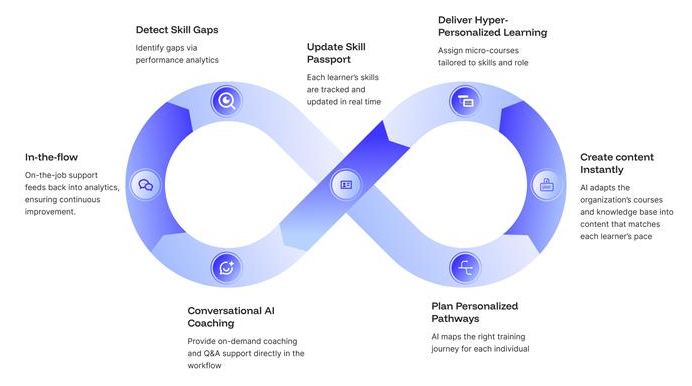
In 2026, leading organizations are replacing static, annual skill audits with a continuous learning loop powered by AI. This loop connects skill detection, learning, coaching, and performance data into a self-improving system. Each part of the loop strengthens the next, creating a dynamic capability engine that evolves in real time.
Here is how the continuous learning loop works:
1. Detect Skill Gaps Automatically
AI analyzes performance data, assessments, behavior signals, and workflow patterns to identify missing or weak skills. Instead of relying on surveys or manager opinions, skill gaps are revealed through real work, giving a far more accurate view of workforce capability.
2. Update Skill Passport in Real Time
Each employee has a living skill profile that updates continuously.
As people learn, complete tasks, or demonstrate new behaviors, their skill passport reflects the change instantly. This creates a constantly accurate record of role readiness and capability levels.
3. Deliver Training in the Flow of Work
Instead of sending employees away to take long courses, AI delivers the right learning at the moment of need. This includes microlearning, job aids, quick steps, visual explanations, or small training units embedded inside daily workflows. Learning becomes part of work, not separate from it.
4. Create or Adapt Content Instantly
AI Course Creator transforms organizational knowledge, documents, SOPs, and manuals into personalized training content. Content automatically aligns to each learner's role, pace, and skill level. This eliminates long content production cycles and ensures training is always up to date.
5. Plan Personalized Pathways
AI creates a tailored training pathway for each employee, mapping exactly what they need to learn, in what order, and at what depth. These pathways adapt automatically as skill levels change, ensuring continuous development aligned with career goals and business needs.
6. Provide Conversational AI Coaching
Learners can ask questions, request help, or get clarification at any time. Conversational AI acts as a real-time coach, offering support, Q&A, and guidance directly inside the workflow. This reduces dependency on managers and accelerates learning.
7. Feed Insights Back into Analytics
Every learning action, job task, or coaching interaction generates new data.
This data feeds back into the system, strengthening future recommendations, improving accuracy, and closing skill gaps even faster. The loop becomes smarter over time, continuously optimizing capability building.
How Skills Gap Analysis Connects to Capability Building
A skills gap analysis shows where employees stand today. Capability building prepares them for what roles will demand tomorrow. The two are directly linked, especially as AI accelerates how fast skills change.
- Skills gap analysis identifies gaps, risks, and priorities.
- Capability building uses those insights to strengthen long-term adaptability.
- AI connects both by turning skill data into personalized learning, coaching, and continuous development.
Instead of treating skills as isolated checklists, organizations now map gaps to broader capabilities such as problem-solving, communication, decision-making, digital confidence, and leadership behaviors. This shifts skill analysis from a one-time exercise into a continuous capability engine that evolves with people, performance, and business needs.
What Is Capability Building?
Capability building is the process of developing the broader, long-lasting abilities that allow individuals and teams to perform effectively in evolving roles. Skills are specific and task oriented. Capabilities combine skills, behaviors, knowledge, mindsets, and judgment. Capabilities endure longer and determine adaptability in a changing workplace.
Why Capability Building Matters in 2026
Skills matter, but capabilities determine whether employees can adapt as roles change.
- Skills change fast
- Capabilities endure
- Capability driven organizations innovate faster
Capability building is becoming the core operating system for future-ready organizations.
Train Your Existing Workforce: Why Upskilling Beats Hiring
Hiring is slower, costlier, and riskier than upskilling.
Upskilling delivers higher retention, faster productivity, lower onboarding cost, and better internal mobility.
KPIs for Measuring Skills Gap Analysis and Upskilling Impact
- Skill proficiency score
- Skill gap closure rate
- Time to skill
- Training completion rate
- Training application score
- Role readiness score
- Internal mobility rate
- Productivity improvements
- Manager capability confidence
- Learning path effectiveness
- Accuracy of AI recommendations
Skills First Capability Building Is Now Essential
Skill gaps will continue to grow unless organizations adopt a structured and AI augmented approach to capability development.
Skill gap analysis provides clarity.
AI provides accuracy. Capability building provides resilience.
The organizations that embrace skills first learning, AI driven capability building, and data informed L&D practices will lead in 2026 and beyond.
FAQ
1. What is the difference between skills and capabilities?
Skills are specific, task level abilities, while capabilities integrate skills, behaviors, experience, and judgment to deliver outcomes.
2. How does AI help identify skill gaps?
AI analyzes assessments, performance data, work outputs, and behavior to infer skill proficiency and predict future gaps.
3. How often should a skills gap analysis be conducted?
Traditionally once a year, but in 2026 organizations use continuous skill intelligence updated in real time.
4. What is a skills gap analysis template?
A structured framework for identifying, measuring, and addressing skill gaps. The 5 step framework in this blog works as a practical template.
5. Why is capability building more important than skill training?
Skills become outdated quickly due to AI and automation, while capabilities like problem-solving, adaptability, and smart decision-making stay relevant even as tools change. Modern agentic AI learning platforms are designed to strengthen these durable capabilities, not just deliver training modules.