
Quick Answers
Which LMS is best for professional training companies and academies specifically?
Blend-ed, Docebo, and LearnUpon are all viable, but Blend-ed is designed primarily around cohort-based delivery, multi-client management, and paid-programme monetisation for training businesses.
Do any of these platforms publish real pricing?
TalentLMS and 360Learning offer the clearest self-service pricing, $119 a month and $8 per active user a month respectively. Sana provides indicative pricing above a minimum user threshold. Most others, including Blend-ed, price on a custom quote basis.
Is a traditional LMS still enough in 2026, or do I need AI features?
A traditional LMS still works for compliance tracking and completion. Skills intelligence and continuous upskilling need an AI-native or AI-augmented platform.
Is this a ranking from best to worst?
No. These 10 are organised by buyer use case, training companies, enterprises, customer education, frontline workforces, not a single best-to-worst scale.
How much does an AI LMS actually cost?
Published starting prices range from about $1,400 a year at TalentLMS's $119 monthly rate to $8 per active user a month with 360Learning. Most other platforms, including Blend-ed, are quote-based, so total cost depends heavily on user volume and contract terms.
Most LMS comparisons treat internal compliance training, customer education, workforce upskilling, and professional training delivery as though they all need the same platform. They don't. A system built for internal onboarding rarely fits a training company selling certified programmes to external clients, and a platform built for extended-enterprise compliance training rarely fits a business whose product is the training itself.
A IBM and Oxford Economics survey of roughly 3,000 global executives found they expect 40 percent of their workforce, an estimated 1.4 billion people, to need reskilling within three years because of AI. That's why skills intelligence, not just completion, is now a real evaluation criterion.
This guide compares 10 LMS and AI-powered learning platforms by use case, AI capability, delivery model, pricing, and G2 feedback, not on a single best-to-worst scale.
How We Evaluated These LMS Platforms
Each platform is assessed against the same criteria: AI course creation, AI tutoring, skills intelligence, cohort and instructor-led delivery, blended and self-paced learning, extended-enterprise support, multi-tenant management, ecommerce and monetisation, integrations, multilingual delivery, pricing transparency, and G2 ratings.
Notes draw on published vendor information, G2 reviews, and pricing details available at the time of writing, not hands-on testing of every platform. Unclear evidence is marked "not publicly confirmed" rather than guessed at.
This guide is published by Blend-ed. Our own platform section therefore includes additional first-party product and customer information, while competitor assessments rely on publicly available vendor documentation, pricing information, and user reviews.
What Is an LMS, and What Makes One AI-Powered?
A learning management system delivers, manages, tracks, and reports on training: enrolment, learning paths, assessments, certification, and analytics.
An AI-powered learning platform adds faster content creation, an AI tutor or knowledge assistant, skills mapping and gap detection, personalised learning paths, and automated learning operations. A traditional LMS tracks course completion. An AI-powered platform tracks something closer to actual readiness.
How AI Is Changing LMS Platforms in 2026
AI is changing what buyers expect from a learning platform: faster course creation from source documents; AI tutors becoming standard rather than a novelty; skills mapping and gap detection replacing completion tracking; recommendations tied to a learner's actual role; more automated administration, from enrolment to re-certification; deeper integration with HRIS and CRM; and improving multilingual delivery, including right-to-left languages such as Arabic, though depth still varies between vendors.
LMS and AI-Powered Learning Platforms Comparison (2026)
Two tables below cover learning and AI capabilities, then commercial and delivery capabilities. A capability is marked "Yes" only where vendor documentation or other reliable evidence confirms it, "Plan-dependent" where it exists only on certain packages, and "Not publicly confirmed" where the evidence available for this article wasn't sufficient either way, not because the platform necessarily lacks it.
Learning and AI Capabilities
| Platform | Best For | AI Course Creation | AI Learner Assistant | Skills or Competency Tracking | Instructor-Led or Cohort Delivery |
|---|---|---|---|---|---|
| Blend-ed | Training companies, academies, accredited programmes | Yes | Yes | Yes | Yes |
| 360Learning | SME-driven internal training | Yes | Plan-dependent | Plan-dependent | Plan-dependent |
| Docebo | Large enterprises | Not publicly confirmed | Not publicly confirmed | Not publicly confirmed | Not publicly confirmed |
| Absorb LMS | Compliance, extended enterprise | Yes | Yes | Yes | Yes |
| Sana | Knowledge-centric organisations | Yes | Yes | Not publicly confirmed | Not publicly confirmed |
| Cornerstone | Enterprises in the Cornerstone ecosystem | Yes | Not publicly confirmed | Yes | Not publicly confirmed |
| LearnUpon | Customer and partner education | Yes | Not publicly confirmed | Not publicly confirmed | Not publicly confirmed |
| CYPHER Learning | Compliance, gamified competency training | Yes | Not publicly confirmed | Yes | Not publicly confirmed |
| TalentLMS | SMBs, fast deployment | Yes | Not publicly confirmed | Not publicly confirmed | Not publicly confirmed |
| Disprz | Frontline, distributed workforces | Not publicly confirmed | Not publicly confirmed | Yes | Not publicly confirmed |
Commercial and Delivery Capabilities
| Platform | Multiple Portals/Orgs | Ecommerce | Multilingual/RTL | Public Pricing | G2 Rating |
|---|---|---|---|---|---|
| Blend-ed | Yes | Yes | Yes (Arabic, RTL) | Quote-based | 5.0/5 from 1 review |
| 360Learning | Plan-dependent | Not publicly confirmed | Yes (26 languages; RTL not confirmed) | Published (Team plan) | 4.6/5 from 583 reviews |
| Docebo | Not publicly confirmed | Not publicly confirmed | Not publicly confirmed | Quote-based | 4.3/5 from 741 reviews |
| Absorb LMS | Yes | Yes | Yes (RTL not confirmed) | Quote-based | 4.6/5 from 908 reviews |
| Sana | Not publicly confirmed | Not publicly confirmed | Yes (RTL not confirmed) | Indicative, above a user threshold | 4.8/5 from 106 reviews |
| Cornerstone | Not publicly confirmed | Not publicly confirmed | Not publicly confirmed | Quote-based | 4.1/5 from 530 reviews (Learning listing) |
| LearnUpon | Yes | Not publicly confirmed | Not publicly confirmed | Quote-based | 4.5/5 from 255 reviews |
| CYPHER Learning | Not publicly confirmed | Not publicly confirmed | Not publicly confirmed | Quote-based | 4.4/5 from 319 reviews |
| TalentLMS | Not publicly confirmed | Not publicly confirmed | Not publicly confirmed | Published | 4.6/5 from 794 reviews |
| Disprz | Not publicly confirmed | Not publicly confirmed | Not publicly confirmed | Quote-based | 4.5/5 from 79 reviews |
Ratings are from G2, checked in this pass on 1 July 2026, a snapshot rather than a permanent score. Blend-ed's 5.0/5 is based on a single review and should be read as an early signal, not a statistically meaningful sample. Cornerstone Learning is a distinct G2 listing from the broader Cornerstone OnDemand company listing; figures above are for the Learning listing specifically. A per-active-user monthly price and a platform-level monthly price are different pricing models, not directly comparable, see the pricing note under each platform below.
Best LMS Platforms by Use Case
- Professional training companies and academies: Blend-ed, for cohort-based delivery, multi-client management, and paid-programme monetisation.
- Large enterprise learning: Docebo or Cornerstone, especially Cornerstone if you're already in its talent-management ecosystem.
- Customer and partner education: LearnUpon, for multi-portal delivery and CRM integrations.
- SME-led collaborative learning: 360Learning, for peer and subject-matter-expert content creation.
- Small businesses and fast deployment: TalentLMS, for published pricing and a genuine free tier.
- Knowledge-centric organisations: Sana, for AI knowledge assistants embedded in daily work.
- Frontline and distributed workforces: Disprz, for mobile-led delivery across India, Southeast Asia, and the Middle East.
- Compliance-heavy extended-enterprise training: Absorb LMS, for admin controls and multi-tenant, ecommerce-enabled delivery.
This is a starting point for shortlisting, not a substitute for a demo. Several platforms fit more than one category.
The 10 Best LMS Platforms and AI-Powered Learning Platforms (2026)
1) Blend-ed

Overview
Blend-ed is an AI-powered learning platform built for organisations that deliver training as the business itself: training companies, professional academies, and education providers running certified or credentialed programmes for external clients. It combines LMS, LXP, and AI authoring in one system, built on Open edX.
Key Features
- AI Course Creator that turns documents and training materials into structured courses
- AI Tutor and Knowledge Assistant supporting learners during and after courses
- Skills analytics and AI-driven skill gap detection across programmes and cohorts
- Cohort-based, instructor-led, self-paced, and blended delivery in one system
- Multilingual delivery, including Arabic and right-to-left (RTL) support, plus training monetisation and multi-client accounts
Best For
Training companies, professional academies, and continuing education providers managing multiple programmes or client organisations, particularly in regulated industries.
Pros
- Designed primarily around external training delivery: multi-client management, cohorts, and paid-programme monetisation in one system
- AI authoring and learner support combined in one platform rather than separate tools
- Multilingual delivery, including Arabic and RTL, built on Open edX rather than a closed proprietary core
Cons
- Quote-based pricing makes early comparison less immediate than with fully self-serve platforms like TalentLMS or 360Learning
- Advanced skills frameworks, multi-client structures, and reporting need proper initial configuration to match how a specific training business runs
What G2 Users Say
Blend-ed's G2 profile is new, with one five-star review, from a training-company founder: "The built-in AI support is impressive and extremely helpful when it comes to developing new courses. It makes the process much smoother and more efficient." This is a single review, not yet a statistically meaningful sample.
Why It Stands Out
One of the few platforms here built primarily for training businesses managing multiple clients, cohorts, and certification programmes at once. Two customer examples illustrate the range: Risknowlogy uses Blend-ed to deliver functional safety training programmes, including TÜV SÜD-approved IEC 61508 training, and Health on Cloud uses Blend-ed to deliver accredited CME and CPD programmes.
Pricing
Two tiers, Core and Enterprise, both quote-based, priced as a platform subscription rather than strictly per user. Get a quote directly; there's no published rate card.
2) 360Learning
Overview
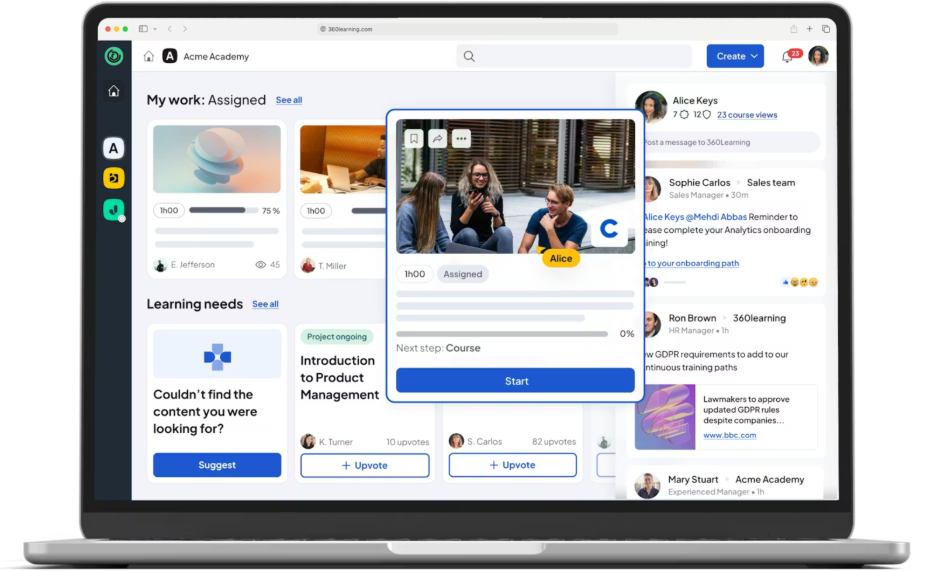
360Learning pairs an AI-powered LMS with collaborative workflows that let subject matter experts co-create and improve content, rather than routing everything through one central authoring team.
Key Features
- AI-assisted course creation from existing documents
- Collaborative authoring with SME feedback loops built in
Best For
SME-driven internal training teams that want subject matter experts to help build courses.
Pros
- Strong fit for a decentralised, SME-driven learning culture
- One of two platforms here with published, self-service pricing
Cons
- External-audience and monetisation workflows sit at the Enterprise tier rather than the self-serve Team plan; confirm current scope directly if this is a requirement
- Buyers requiring advanced skill taxonomies, proficiency levels, and readiness reporting should review these workflows in a product demonstration
What G2 Users Say
4.6/5 from 583 reviews on G2, confirmed directly on 360Learning's G2 listing.
Pricing
Published vendor pricing: Team plan, $8 per active user per month, for up to 100 users, billed monthly with no annual commitment. 360Learning's own pricing FAQ states the Team plan bills on active users, not registered users. Business and Enterprise tiers support flexible registered-user, active-user, or blended models and are quote-based ("Schedule a Demo").
3) Docebo
Overview
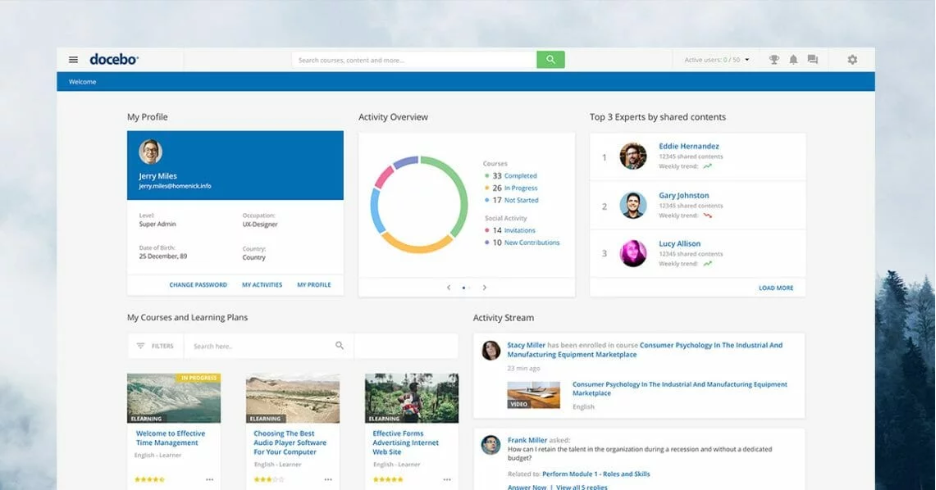
Docebo is an enterprise learning platform with AI features spanning content discovery, personalisation, and automation.
Key Features
- AI-driven content recommendations and search
- Deep enterprise integrations
Best For
Large enterprises with a dedicated L&D operations team and budget for a multi-year rollout.
Pros
- Mature enterprise ecosystem with a long track record
- Strong automation and personalisation once fully configured
Cons
- Several reviewers describe a steep learning curve during initial setup; large or regulated organisations should plan for onboarding time accordingly
- Buyers should confirm exactly which modules and services are included at each pricing tier before comparing cost
What G2 Users Say
4.3/5 from 741 reviews. One Senior Instructional Designer wrote: "I like Docebo's user interface as an admin because it's easy to use and delivers faster results."
Pricing
Pricing is quote-based and varies according to user volume, modules, implementation, support, and contract structure. Docebo does not publish an indicative starting price on its own site; third-party marketplace estimates exist but are not vendor-confirmed. Request a complete quote directly from Docebo.
4) Absorb LMS
Overview
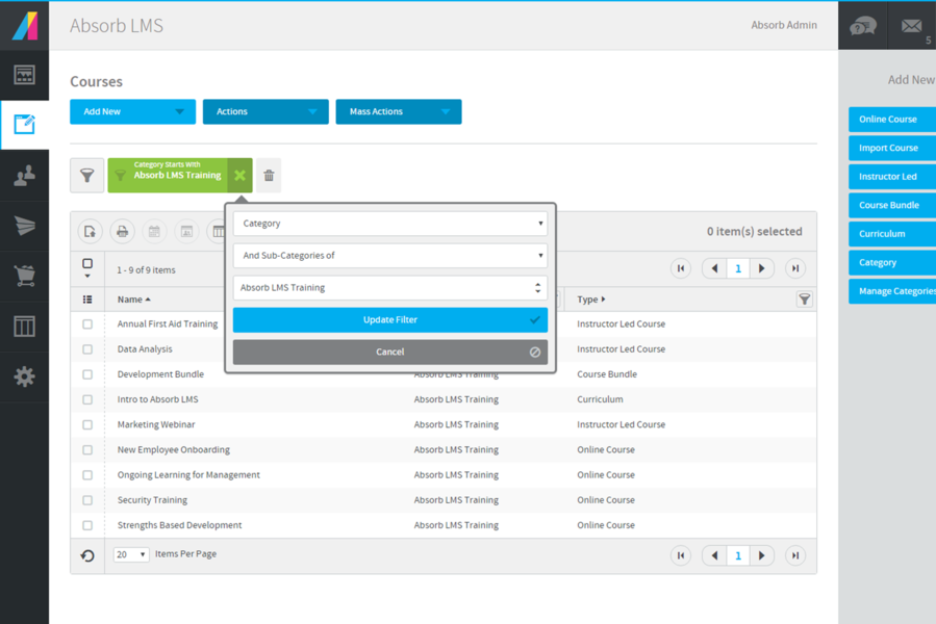
Absorb is a widely used LMS for training at scale, with AI features under "Absorb Intelligence" and particular strength in admin control and extended-enterprise delivery.
Key Features
- AI-powered administrative workflows and AI-generated course content ("Create AI")
- Multi-tenant and ecommerce support for extended-enterprise training
- Role-based skill paths ("Absorb Skills") and instructor-led training support
Best For
Organisations running compliance-heavy or extended-enterprise training that want strong admin controls alongside AI features.
Pros
- Strong fit for compliance and operational training
- Multi-tenant and ecommerce support confirmed as core, vendor-documented features
Cons
- Buyers should confirm which plan tier includes full AI functionality, since AI depth can vary across Absorb's packages
- Buyers requiring advanced skill taxonomies, proficiency levels, and readiness reporting should review these workflows in a product demonstration
What G2 Users Say
4.6/5 from 908 reviews, the largest review base here. One HR Advisor wrote: "The platform is incredibly easy to use and feels intuitive for both administrators and staff." Ease of use and responsive support are recurring themes across the reviews examined.
Pricing
Pricing is quote-based and varies according to user volume, modules, implementation, support, and contract structure. Request a complete quote directly from Absorb.
5) Sana
Overview
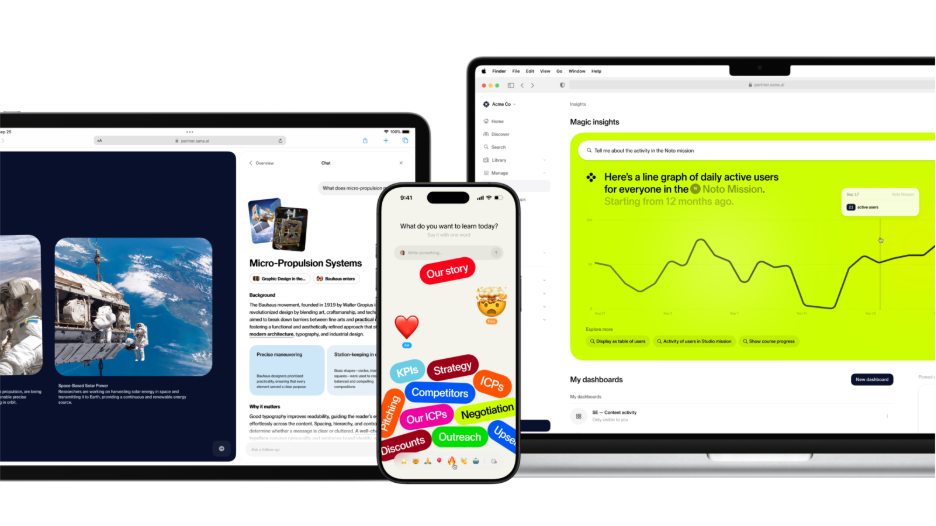
Sana positions itself as an AI-native learning and knowledge platform, built around knowledge tools for work rather than a traditional course catalogue.
Key Features
- AI-powered authoring that turns source material into courses
- An AI Tutor built into the learner experience
- Enterprise-grade security and governance
Best For
Knowledge-centric organisations that want learning built into daily workflow tools rather than a separate destination.
Pros
- Strong alignment with learning inside the actual flow of work
- AI Tutor and AI-authoring confirmed directly on Sana's own product pages
Cons
- Organisations relying heavily on structured course catalogues or formal certification tracking should confirm these workflows fit their needs during a demo
- Multi-tenant and extended-enterprise support isn't detailed publicly; confirm directly if you need to serve external audiences
What G2 Users Say
4.8/5 from 106 reviews, the highest rating here, though from a smaller review base than several competitors. One Enterprise Account Executive wrote: "I love how intuitive and easy to pick up Sana Learn's UI is." Ease of use is a recurring theme in the reviews examined.
Why It Stands Out
Holds the highest G2 rating of the 10 platforms compared here, and reviewers repeatedly mention how quickly new users become productive.
Pricing
Sana publishes an indicative pricing tool directly on its site, priced per user per month and banded by organisation size (below 300 users, 300 to 3,000, or above 3,000). Sana's own pricing page states plans start at 300 users; the exact per-user figure requires booking an intro call, and enterprise pricing above that is fully custom.
6) Cornerstone
Overview
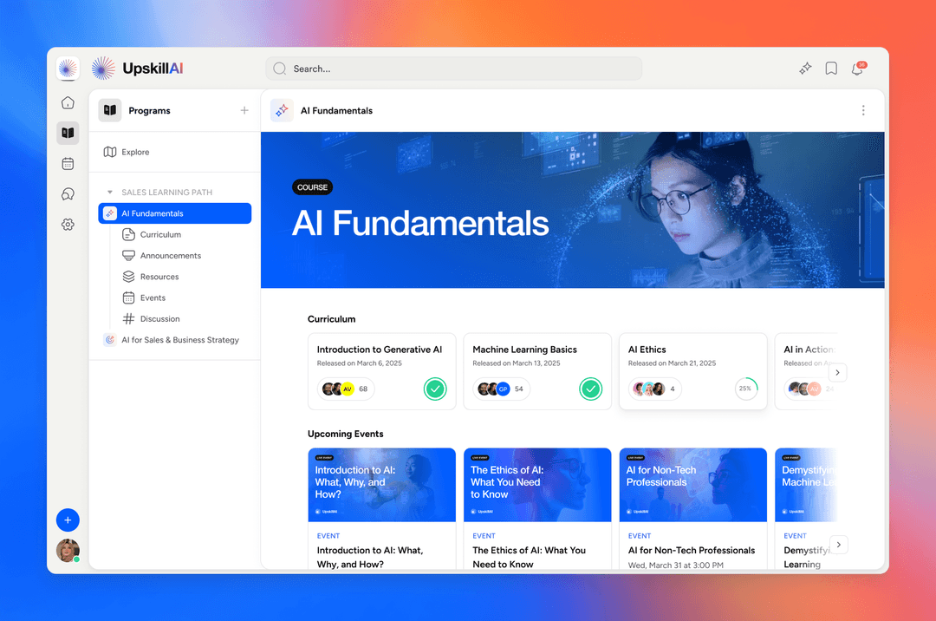
Cornerstone spent 2026 rebuilding itself around AI, folding learning, performance, and compliance into one system, Cornerstone Galaxy, built on the Cornerstone Skills Graph, a dataset covering more than 50,000 skills.
Key Features
- AI-Powered Course Assistant for faster course and assessment creation
- Adaptive Learning Agent that adjusts learning paths automatically
- Cornerstone Skills Graph, matching individual skills to roles and content
Best For
Large, established enterprises already invested in Cornerstone's talent-management suite that want AI layered onto existing workflows.
Pros
- Deep, long-running skills data behind its recommendations
- Substantial 2026 AI investment, not a rebrand of existing features
Cons
- Large-scale rollouts should include a realistic implementation timeline and a clear breakdown of pricing across tiers as part of evaluation
- Some reviewers mention older content persisting from earlier releases and describe support as feeling outsourced; worth asking about directly during evaluation
What G2 Users Say
4.1/5 from 530 reviews on the Cornerstone Learning listing specifically (the broader Cornerstone OnDemand company listing is a different listing, not to be confused with this one). Reviewers value centralised historical data, but some note "old content in there from years ago."
Pricing
No reliable public pricing found. Quote-based, tied to organisation size and modules, contact Cornerstone's sales team directly.
7) LearnUpon
Overview
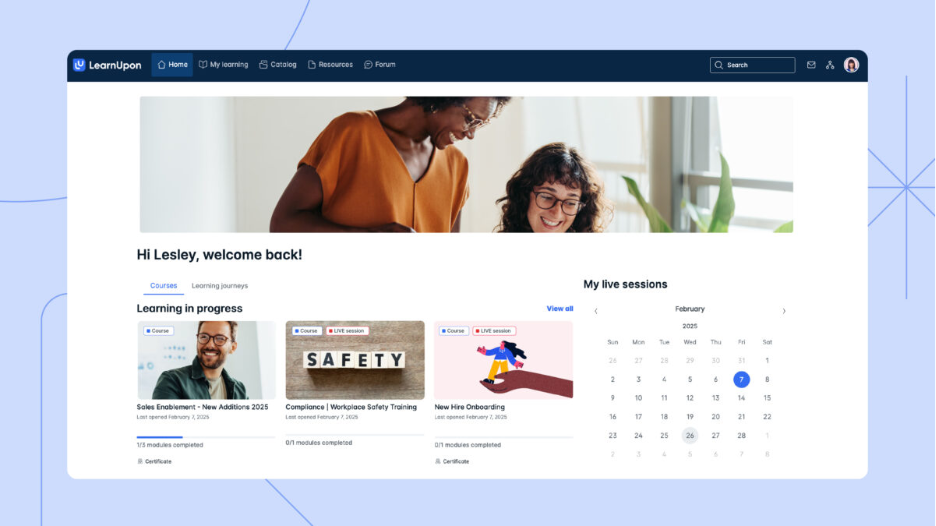
LearnUpon is a well-known LMS for customer training and extended-enterprise use cases, with a strong focus on reporting and integrations.
Key Features
- AI-powered course authoring, called out directly by reviewers
- Multi-portal delivery for different audiences
Best For
SaaS companies and other B2B vendors combining customer training and internal onboarding in one portal, especially on HubSpot.
Pros
- Strong fit for customer and partner training specifically
- Multi-portal delivery confirmed as a core, vendor-documented feature
Cons
- Buyers prioritising deep AI authoring or skills intelligence over customer-education workflows should compare feature depth directly with the vendor
- Pricing runs noticeably higher than some alternatives, reviewers note this directly
What G2 Users Say
4.5/5 from 255 reviews. One Legal Lead and Account Manager wrote: "The HubSpot integration is best-in-class and the AI-powered course authoring tool has dramatically cut down the time it takes us to build and update content."
Pricing
Pricing is quote-based and varies according to user volume, modules, implementation, support, and contract structure. Request a complete quote directly from LearnUpon.
8) CYPHER Learning
Overview
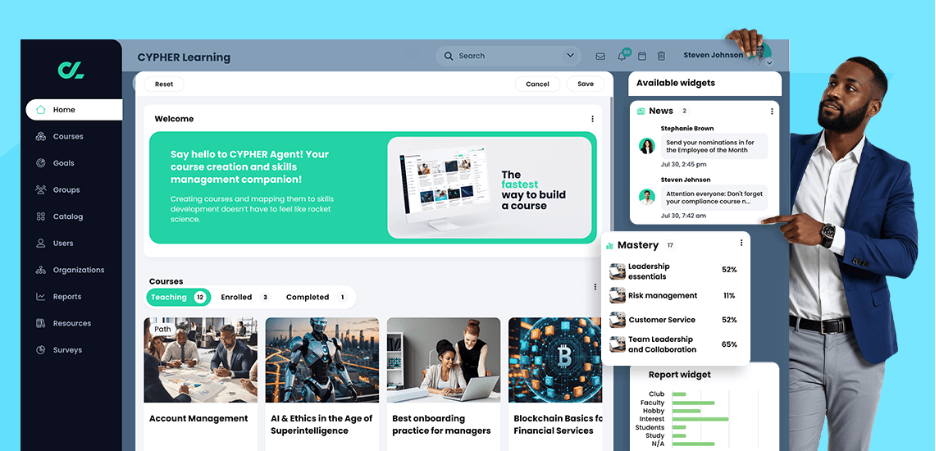
CYPHER Learning is an all-in-one AI-powered platform spanning education and enterprise use cases, with "CYPHER Agent" handling course creation, gamification, and assessments.
Key Features
- AI-powered course creation, including multimedia and assessments
- Competency-based learning aligned to specific skills
Best For
Organisations juggling compliance training and gamified, competency-based development in one platform.
Pros
- Balanced focus on automation and learner support
- Suitable for operational learning environments needing structure and flexibility
Cons
- Some reviewers describe the platform as complex, with a real learning curve
- Large or regulated organisations should validate governance, audit, security, data residency, and compliance requirements directly with the vendor
What G2 Users Say
4.4/5 from 319 reviews. G2's own buyer data adds concrete numbers most listings don't: an average 3-month implementation time, a 17-month ROI payback period, and a 12 percent average negotiated discount.
Pricing
Pricing is quote-based and varies according to user volume, modules, implementation, support, and contract structure. Request a complete quote directly from CYPHER Learning.
9) TalentLMS
Overview
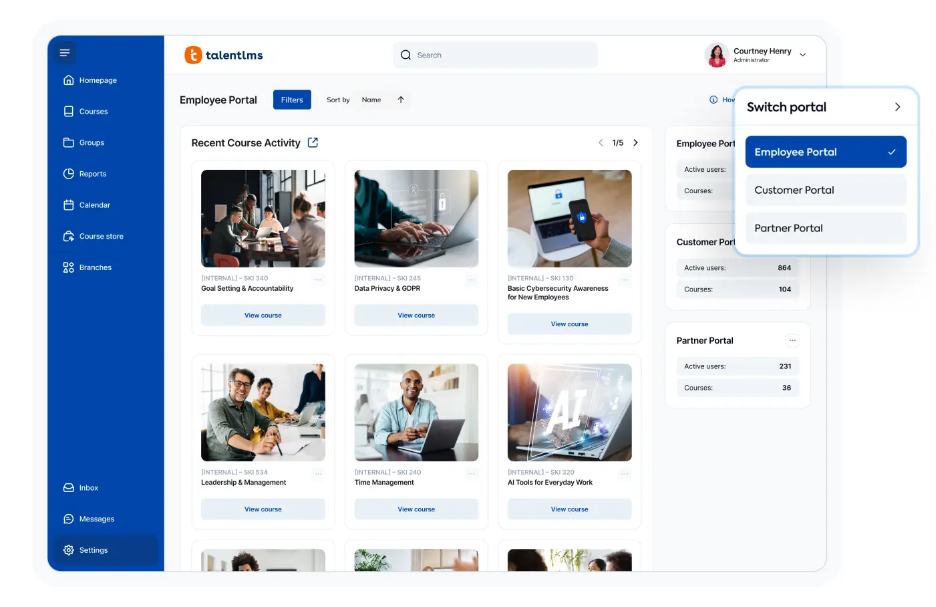
TalentLMS is built for fast deployment and ease of use, adding practical AI features for course creation and assessment without losing that simplicity.
Key Features
- AI-assisted course creation
- Built-in assessment generation
Best For
SMBs and fast-moving teams that want to be live within days and know exactly what they'll pay upfront.
Pros
- Fast setup and an intuitive interface reviewers praise repeatedly
- A genuinely usable free tier, not just a time-limited trial
Cons
- Buyers requiring advanced skill taxonomies, proficiency levels, and readiness reporting should review these workflows in a product demonstration
- Real price jumps between tiers as user counts grow, several reviewers note this directly
What G2 Users Say
4.6/5 from 794 reviews. Reviewers repeatedly describe it as "one of the most cost-effective" platforms in the category, with "value for money" a recurring phrase.
Pricing
Published vendor pricing, priced as a platform-level monthly subscription rather than per user: Free for very small teams, Core from $119 a month, Grow from $229 (annual billing), Pro above that, plus custom Enterprise pricing. At the $119 starting price, that works out to approximately $1,400 a year before any discount for annual billing.
10) Disprz
Overview
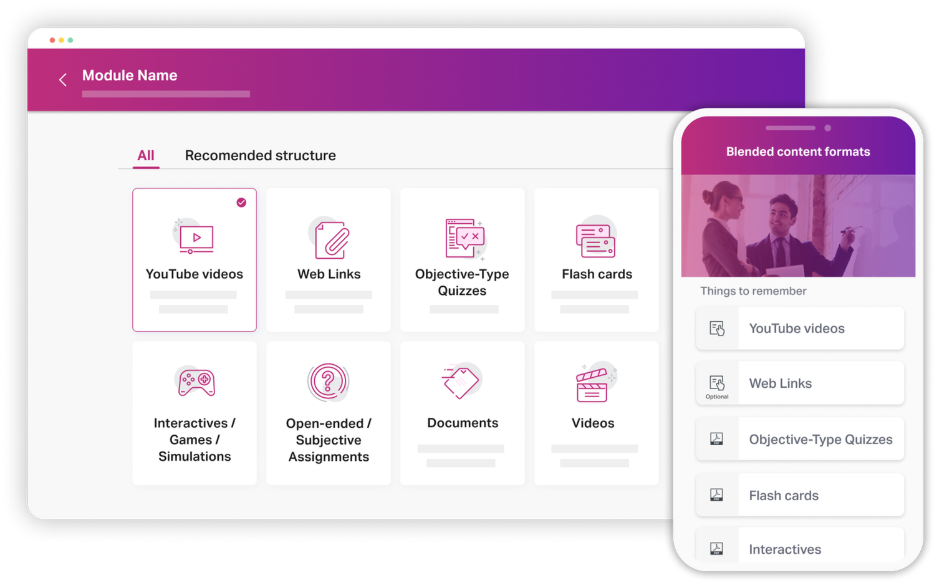
Disprz is a skills and learning platform focused on upskilling and reskilling, with mobile-led delivery built for distributed and frontline teams across India, Southeast Asia, and the Middle East.
Key Features
- AI-driven course and skill recommendations
- Mobile-led delivery designed for frontline and field teams
Best For
Large, distributed workforces, retail, frontline, and multi-country operations, that prioritise continuous upskilling over a course catalogue.
Pros
- Strong fit for upskilling and reskilling initiatives at scale
- Effective for frontline and distributed teams who rarely sit at a desk
Cons
- Better suited to internal upskilling than external, monetised training delivery; confirm fit directly if you need to serve paying external audiences
- Public detail on standards support (SCORM, LTI, xAPI) is limited, confirm current capability with the vendor
What G2 Users Say
4.5/5 from 79 reviews, the smallest review base here, worth keeping in mind when weighing the rating. Reviewers describe the platform as "SO easy to use" and "Engaging, Intuitive and Empowering."
Pricing
No reliable public pricing found. Predominantly custom, enterprise quote-based.
Key Factors to Consider When Choosing the Right AI LMS
- Skills-First Capability and Analytics Leadership Trusts: Skill taxonomy, gap detection, role-readiness dashboards, evidence tracking through projects and manager validation, and exportable reports or API/BI integration.
- AI That's Actually Usable: Authoring that genuinely cuts time-to-publish, a tutor grounded in approved content, and recommendations that improve relevance instead of adding noise.
- Operational Automation and Integrations: Enrolment rules, reminders, re-certification cycles, cohort scheduling, admin workflows with audit logs, SSO, HRIS and CRM connections, and content standards like SCORM, LTI, and xAPI.
- Global Readiness: Localisation depth including right-to-left support where relevant, mobile performance on low bandwidth, and regional compliance expectations.
- Extended Enterprise and Monetisation: Multi-portal or multi-tenant structure, ecommerce and region-specific tax handling, and clear audience segmentation.
- Total Cost and Time to Value: What's included versus an add-on, required onboarding or migration services, and ongoing internal admin effort after go-live.
Conclusion: Choosing the Right LMS in 2026
There is no single best LMS for every organisation. The right fit depends on your audience, delivery model, scale, integrations, and commercial requirements, not on which platform has the longest feature list.
Enterprises with dedicated L&D teams and multi-year rollouts tend toward established platforms like Docebo or Cornerstone. Organisations focused on customer and partner education often fit better with LearnUpon. Teams that want subject matter experts driving content creation gravitate toward 360Learning, while knowledge-centric organisations lean toward Sana. Small businesses that want transparent, self-serve pricing usually start with TalentLMS, and frontline or distributed workforces are often better served by mobile-first platforms like Disprz. Compliance-heavy extended-enterprise training tends to suit platforms like Absorb or CYPHER Learning.
Blend-ed is built for a different starting point: organisations whose core business is training delivery itself, training companies, professional academies, and continuing education providers running certified or credentialed programmes for external clients. Cohort-based delivery, skills intelligence, multilingual and Arabic RTL support, and training monetisation in one system is where Blend-ed fits best.
Before committing to any platform, compare complete workflows rather than feature checklists: implementation effort, total cost across the contract term, support quality, integrations, and how pricing actually scales as your organisation grows.
If your organisation delivers training as a business rather than as an internal function, book a Blend-ed demo to see how cohort-based delivery, AI course creation, and skills tracking work together in one platform.
Frequently Asked Questions
What is the best LMS for professional training companies?
Platforms built around cohort-based delivery, multi-client management, and paid-programme monetisation fit best, since training companies sell learning rather than deliver it internally. Blend-ed is designed primarily around this use case; Docebo and LearnUpon also serve parts of this space.
What is the difference between an LMS and an AI-powered learning platform?
A traditional LMS focuses on course delivery, enrolment, and completion tracking. An AI-powered learning platform adds AI-assisted authoring, an AI tutor or assistant, personalised recommendations, and skills-based analytics.
Which AI LMS features matter most?
Skills intelligence, AI authoring that genuinely cuts production time, automation for enrolments and certifications, and analytics focused on readiness rather than completion.
Which LMS platforms publish pricing?
TalentLMS and 360Learning offer the clearest self-service pricing. Sana provides indicative pricing above a minimum user threshold. Most other platforms, including Blend-ed, are quote-based, so treat other figures in this article as estimates rather than published rates.
How should organisations compare LMS pricing?
Check whether a figure is per active user, per registered user, per month, or a platform-level subscription before comparing vendors. An $8 per-active-user price and a $119 platform-level price aren't the same pricing model.
Are AI LMS platforms suitable for small businesses?
Yes, provided pricing is transparent and time-to-value is short. TalentLMS and 360Learning are the two platforms here with the clearest self-service pricing for smaller teams.
How often should an organisation reassess its LMS?
Every two to three years for most organisations, sooner if learning needs shift toward skills-based models, external training delivery, or large-scale reskilling.
How often is this article updated?
This comparison is reviewed on a regular cycle, most recently July 2026, covering pricing changes, new entrants, and current G2 ratings.