

TL;DR: Agentic AI moves a training platform from a passive tool into an active system that plans, decides, and acts without waiting to be told. For professional training companies, this means courses built in minutes, learners supported in context, and admin tasks that run themselves. This post explains what agentic AI actually does inside a training operation and what to look for in a platform that delivers it today. If you run a professional training company and want to see this in practice, book a demo at blend-ed.com.
Most LMS platforms wait for instructions. You upload a course. You enrol learners manually. You answer the same question seventeen times across seventeen different learners. You chase completions, chase certificates, chase reports.
That model is not a technology problem. It is an architecture problem. The platform is passive. It responds when asked. It does nothing when not.
Gartner projects that 40% of enterprise applications will include agentic AI by the end of 2026, up from less than 5% in 2025. That shift is already reaching training platforms. For professional training companies delivering certified, accredited, and compliance programmes to external clients, it changes how every part of the operation works.
This is not about chatbots or AI-generated summaries. It is about systems that act.
What does agentic AI actually mean for a training company?
Agentic AI is an AI system that can plan, decide, and take action on its own to complete a goal, without a human prompting each step. In a training platform, the system does not wait to be told what to do. It identifies what is needed and does it.
The distinction matters. A standard LMS chatbot answers questions. An agentic system notices a learning need, determines what is required, acts across the relevant workflows, and closes the loop without anyone asking. These are structurally different things.
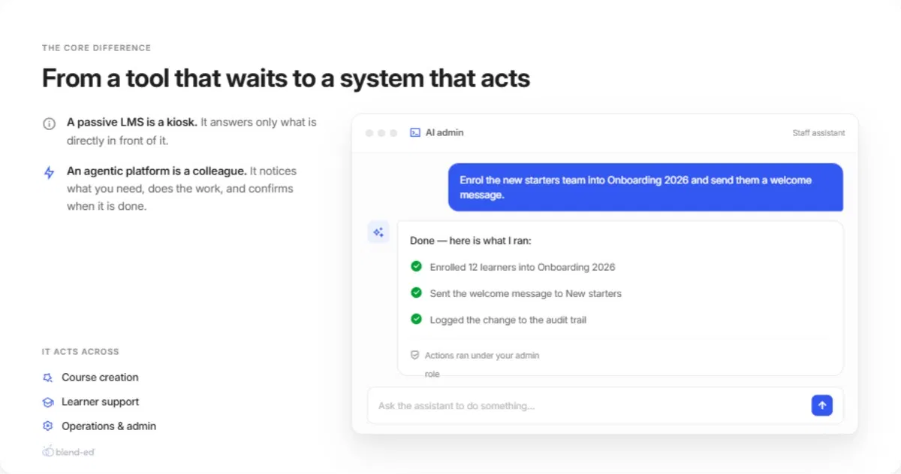
Think of the difference this way. A chatbot in your LMS is a kiosk in a lobby. It answers what is directly in front of it. An agentic system is a competent colleague. It notices what you need before you fully articulate it, does the relevant work, and confirms when it is done.
For a professional training company, that distinction translates into three areas: how courses get built, how learners get supported, and how the operation runs. Each one is worth looking at in detail.
If you want the broader context on how this fits into modern learning design, the Agentic AI-Powered Learning post covers the evolution well.
How agentic AI changes course creation
Building a certified course from scratch is expensive and slow. You write a brief, build an outline, write scripts, hand them to an instructional designer, load content into the LMS unit by unit, add assessments, check everything renders correctly, and publish. For a five-module course, that process takes days. For a twenty-unit certification programme, it takes weeks.
The AI course creator in Blend-ed replaces that process with a four-stage workflow.
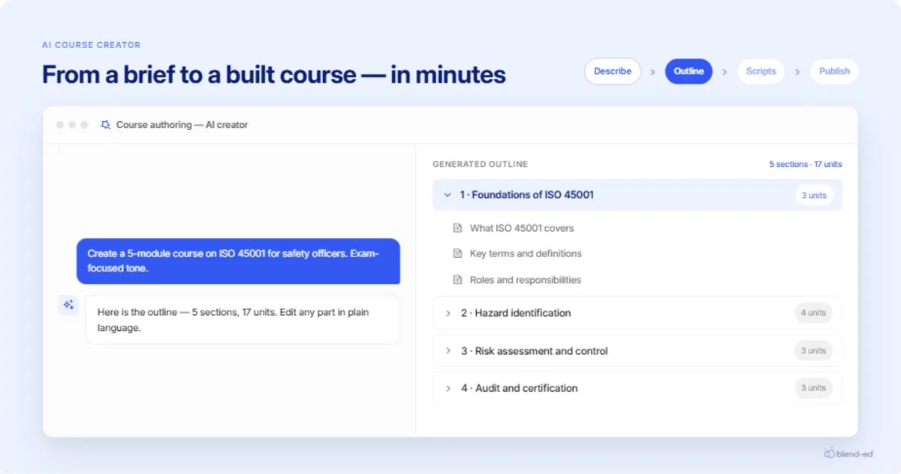
In stage one, you open a chat and describe what you want. Topic, audience, tone, depth, how many units. If you have an existing syllabus or document, you upload it and the AI extracts the structure directly, preserving the exact names and order. A LangGraph agent manages the conversation and ensures it collects everything it needs before moving on.
In stage two, the AI generates the full course outline: a tree of sections, subsections, and units. You can edit it in plain language. “Move the assessment to the end of each section.” “Add a unit on X.” The AI rewrites the structure accordingly.
In stage three, the AI generates content scripts for every unit, tailored to the tone, proficiency level, instructional strategy, and learning objectives you specified. Each script is editable. If you want it shorter or more example-driven, you say so and the AI rewrites just that piece.
In stage four, you trigger the build. The system converts everything into real Open edX XBlocks: actual sections, subsections, units, and components inside the authoring environment, as if a developer had built it by hand. If avatar video is enabled, narration scripts are submitted to HeyGen, rendered as video, and attached automatically.
Coursera's 2026 Job Skills Report identifies AI agents and agentic workflows as the fastest-growing enterprise skill category. The demand for agentic AI skills is growing because the productivity gap between companies using it and companies not using it is already visible. Course creation is one of the clearest examples.
A course that takes a human days or weeks to structure, write, and load can be done in minutes. You spend your time reviewing and refining, not building from scratch.
See it in action. Book a demo and we will walk you through a live course build.
What does an AI tutor do inside a professional training course?
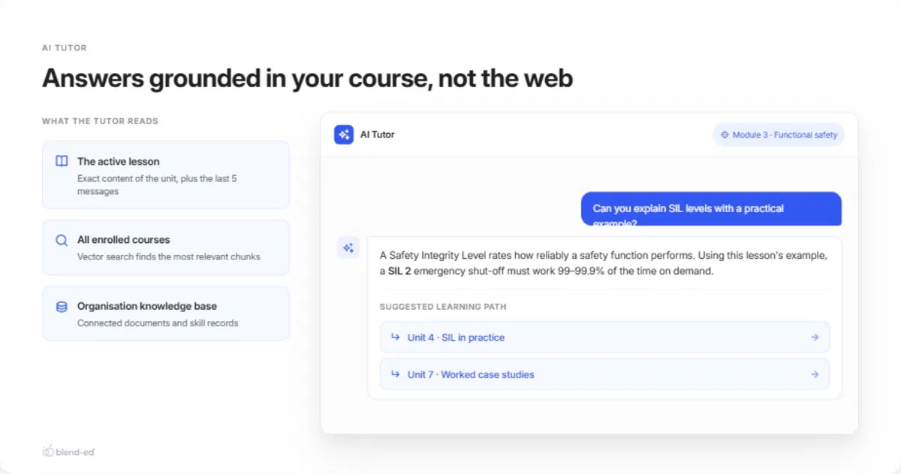
An AI tutor inside a professional training course answers learner questions using the actual lesson content as its knowledge base, not generic web information. A learner studying IEC 61508 functional safety does not get a Wikipedia-level answer. They get an answer drawn from the specific course material they are reading at that moment.
Blend-ed's AI tutor works across two layers, each designed for a different kind of learner need.
The first is the in-unit mentor. When a learner is on a course page and asks a question, the system fetches the content of that specific lesson, including the text and lesson material, and feeds it to the language model as context before processing the question. It also pulls a brief overview of the whole course for broader framing. It keeps the last five messages of the conversation on that unit, so the learner can ask follow-up questions without losing context.
The second is the learner assistant, a more capable agent that operates across the whole learning experience. When a learner sends a message, it converts the question into a vector embedding and runs a similarity search across all content from courses they are enrolled in, finding the most relevant chunks. It also searches the organisation's document knowledge base and any connected knowledge sources using the same method. All relevant chunks are passed to the model alongside the question and conversation history. If the answer points to specific course units, those unit links are returned as a suggested learning path the learner can click through.
The learner assistant also has tools it can use mid-conversation: searching course content on demand, looking up the learner's earned skills, or filing a support ticket.
Gartner predicts that 50% of organisations will introduce AI-free assessments by 2026 as a way to verify genuine learning rather than AI-assisted completion. The response to that pressure is not removing AI from the platform. It is building AI that develops genuine understanding rather than substituting for it. Context-aware tutoring, grounded in course content, moves in that direction.
How agentic AI handles operations for training companies
The administrative load in a professional training company is significant. Enrolling learners into cohorts, managing teams, sending reminders, running reports on who has completed what, answering support tickets, creating new courses on request. For a small operations team running multiple client programmes simultaneously, this is a full-time job.
Blend-ed's AI admin is a staff assistant built for the people running the LMS, not studying in it. You describe what you want in plain English and the system determines which actions to take, calling the right tools behind the scenes.
It handles enrolment: single learners, multiple learners at once, or an entire team into a course or programme. It handles team management: listing learners, looking up what skills a specific learner has earned, seeing who is in a team, creating new teams, adding users. It handles notifications: sending messages to specific learners or entire teams. It handles reporting: who is enrolled in a course, who is enrolled in a programme, all open support tickets with status and assignment.
It also handles course creation. You describe a topic in the staff chat and the system triggers the full AI course creator pipeline in the background, notifying you when the course is ready.
Every action that modifies something is permission-gated by the staff member's role. If you do not have the right permissions, the tool refuses to execute. Read-only lookups are open to all staff.
65% of companies have already automated workflows with agentic AI and expect adoption to grow by another 33% in 2026. The training companies acting on this now are not spending budget on AI experimentation. They are getting time back from tasks that should never have required a person in the first place.
Why professional training companies need agentic AI more than corporate L&D teams
Corporate L&D teams train their own employees. Professional training companies train hundreds of external clients' employees across multiple cohorts, certifications, and compliance standards simultaneously. The operational complexity is an order of magnitude higher.
A corporate L&D team managing a Docebo or Cornerstone implementation has one client: their own organisation. One set of users. One branding. One compliance standard. One certificate template.
A professional training company running on a generic LMS has ten clients, each with their own enrolment lists, their own cohort schedules, their own certificate requirements, and their own reporting expectations. They are also running open public programmes alongside closed client programmes. They are issuing accredited certificates with expiry dates and recertification deadlines. They are producing audit trail evidence for regulators.
The question agentic L&D asks is not “did the employee complete the course?” It asks “did performance actually change?” For a professional training company, that question applies at scale and across multiple client organisations simultaneously.
Generic LMS AI features are built for the simpler model. Explore the LMS for training companies comparison to see exactly where the gaps appear.
What to look for in an LMS with genuine agentic AI capability
Not every platform that mentions AI delivers agentic capability. Here are five questions to ask any vendor.
Does the AI act or just answer?
A chatbot that summarises course content is not agentic. An agent that enrols a cohort, sends notifications, and logs the audit trail from a single plain-English instruction is.
Is the AI trained on your course content or generic web data?
For professional and regulated training, the AI tutor must answer from the actual course material, not from general knowledge. The difference between a correct answer grounded in your ISO 45001 content and a hallucinated answer from the web is significant when a learner is preparing for a certification exam.
Can it execute admin actions or just surface information?
Reporting is useful. Taking action on the report without requiring a human to do so is agentic.
Does it maintain conversation context across sessions?
A system that forgets the previous message is not an agent. Context memory across the learner's entire enrolled programme is the foundation of useful AI support.
Is course creation AI-native or a bolt-on?
A true AI course creator generates the full structure, scripts every unit, and publishes into the LMS automatically. An AI writing assistant that helps you draft text faster is not the same thing.
The AI-first LMS comparison covers how platforms differ on these dimensions in 2026.
Where agentic AI in professional training is heading
The next stage for agentic AI in training is proactive intervention: systems that identify a learner falling behind before they fail an assessment, automatically surface the right content, and flag the issue to a trainer without anyone asking.
For certification training, this closes the gap between course completion and genuine competence. A learner can complete all units and still not be ready to sit an exam. An agentic system that tracks learner interactions, quiz scores, and content engagement can predict that gap and intervene before it becomes a failure.
A compliance requirement changes on a Wednesday. By Thursday morning, an agentic system has identified every employee whose certification no longer meets the new standard, assigned the updated training, set readiness gates, and flagged completion status to the compliance team, without anyone building a rule or running a report. That is the operational standard the market is moving toward.
The agentic AI market is valued at $9.89 billion in 2026 and projected to reach $57.42 billion by 2031, growing at 42% annually. For professional training companies, the relevant question is not whether to adopt agentic AI. It is whether the platform you are on today is built for it.
What this means for your training business
Three things are clear from where the market is in 2026.
First, the operational advantage of agentic AI is not theoretical. Course creation in minutes, learner support grounded in actual course content, admin tasks running from plain-English commands: these are live in Blend-ed today.
Second, the gap between platforms with genuine agentic capability and platforms with AI features bolted on is widening. Asking the five questions above in your next vendor conversation will tell you which side of that line a platform sits on.
Third, the professional training companies that move earliest on this will compress the cost of building and delivering certified programmes in ways their competitors cannot match without the same infrastructure.
If you run a professional training company and want to see what agentic AI looks like inside a platform built for your model, book a demo with the Blend-ed team.
Frequently asked questions
What is agentic AI in the context of professional training?
Agentic AI is an AI system that can plan, decide, and take action on its own to complete a goal, without a human prompting each step. In professional training, this means the platform builds courses, supports learners, and manages admin tasks autonomously. It does not wait to be asked. It identifies what is needed and acts.
How is agentic AI different from a standard LMS chatbot?
A standard LMS chatbot answers questions when prompted. It has no memory of your previous session, no access to your course content, and no ability to take action in the system. An agentic AI system maintains context across the learner's entire programme, answers from actual course content, and can execute actions such as enrolling learners, sending notifications, or generating courses without human input at each step.
Can agentic AI handle certification and compliance workflows?
Yes. The most direct application is audit trail automation: when a compliance requirement changes, an agentic system identifies every affected learner, assigns updated training, enforces readiness gates before role access is restored, and logs everything without a human building a rule or running a report. For accredited and regulated training programmes, this is operationally significant.
How long does it take to build a course using AI course creation?
A course that would take a human days or weeks to structure, script, and load into an LMS can be completed in minutes using an AI course creator. You describe the course, upload any existing materials, review the generated outline and scripts, and trigger the build. The system creates all sections, subsections, units, and components in the LMS automatically. You spend your time reviewing and refining, not building from scratch.
Does agentic AI replace instructors and training managers?
No. Agentic AI handles the operational and administrative layer: course building, learner support at scale, enrolment, notifications, and reporting. Instructors and training managers retain responsibility for programme design, quality assurance, client relationships, and the delivery of live or blended sessions. Agentic AI removes the administrative overhead so trainers can focus on the work that requires human judgment.