
SCORM remains one of the most widely adopted e-learning standards used in corporate training and online education. As digital learning continues to expand, the learning management system market has grown rapidly.
According to Fortune Business Insights, the global learning management system market was valued at USD 18.26 billion in 2023 and is projected to reach USD 82 billion by 2032, driven by the growing adoption of digital learning, corporate training programs, and online education platforms.
Organizations that deliver online training often rely on standardized learning content. Many courses are created using authoring tools such as Blend-ed, Articulate, Captivate, or iSpring and exported as SCORM packages. To deliver these courses effectively, companies need a SCORM compliant LMS.
A SCORM compliant LMS is a learning management system that can upload, play, and track SCORM-based courses. These systems allow organizations to monitor learner progress, completion status, quiz scores, and other learning data from SCORM content.
For training providers, academies, and enterprise learning teams, SCORM compatibility ensures that learning content can work across multiple platforms without needing to be rebuilt each time.
Key Takeaways
- What a SCORM compliant LMS is
- How SCORM works inside an LMS
- The difference between SCORM 1.2 and SCORM 2004
- Why organizations use SCORM compliant LMS platforms
- What to look for in a SCORM compliant LMS
- Whether all LMS platforms support SCORM
What is a SCORM Compliant LMS?
A SCORM compliant LMS is a learning management system that supports the Sharable Content Object Reference Model (SCORM) standard.
SCORM is a set of technical specifications developed by the Advanced Distributed Learning Initiative (ADL) to standardize how online learning content interacts with an LMS.
When an LMS is SCORM compliant, it can:
- Upload SCORM packages
- Play SCORM learning modules
- Track learner progress and completion
- Record assessment scores
- Communicate with SCORM content through the SCORM API
In simple terms, a SCORM compatible LMS allows organizations to deliver standardized e-learning content without worrying about compatibility issues between authoring tools and the LMS platform.
Many corporate training programs, certification courses, and compliance learning programs rely on SCORM compatible learning management systems to manage training content efficiently.
What Does SCORM Compliance Mean in an LMS?
SCORM compliance means that an LMS can communicate with SCORM learning content using a standardized API.
A typical SCORM package includes:
- Course content files
- A manifest file
- Metadata describing the course structure
- JavaScript communication with the LMS
When a learner launches a SCORM course, the SCORM content communicates with the LMS using the SCORM API.
This communication allows the LMS to track:
- Course completion
- Time spent on the course
- Quiz scores
- Learner progress
- Bookmarking (resume where the learner left off)
Without SCORM compliance, the LMS cannot properly track the learner's interaction with the course.
For organizations delivering structured learning programs, this SCORM tracking capability is essential.
How SCORM Works Inside a Learning Management System
Understanding how SCORM works inside an LMS helps explain why SCORM compliant LMS platforms are widely used in online training.
The process typically follows these steps:
- A course creator builds content using an authoring tool.
- The course is exported as a SCORM package.
- The SCORM package is uploaded to the LMS.
- The LMS launches the SCORM course using a built-in SCORM player.
- The SCORM content communicates with the LMS through the SCORM runtime API.
- The LMS records learning data such as completion, progress, and scores.
The interaction can be visualized as:
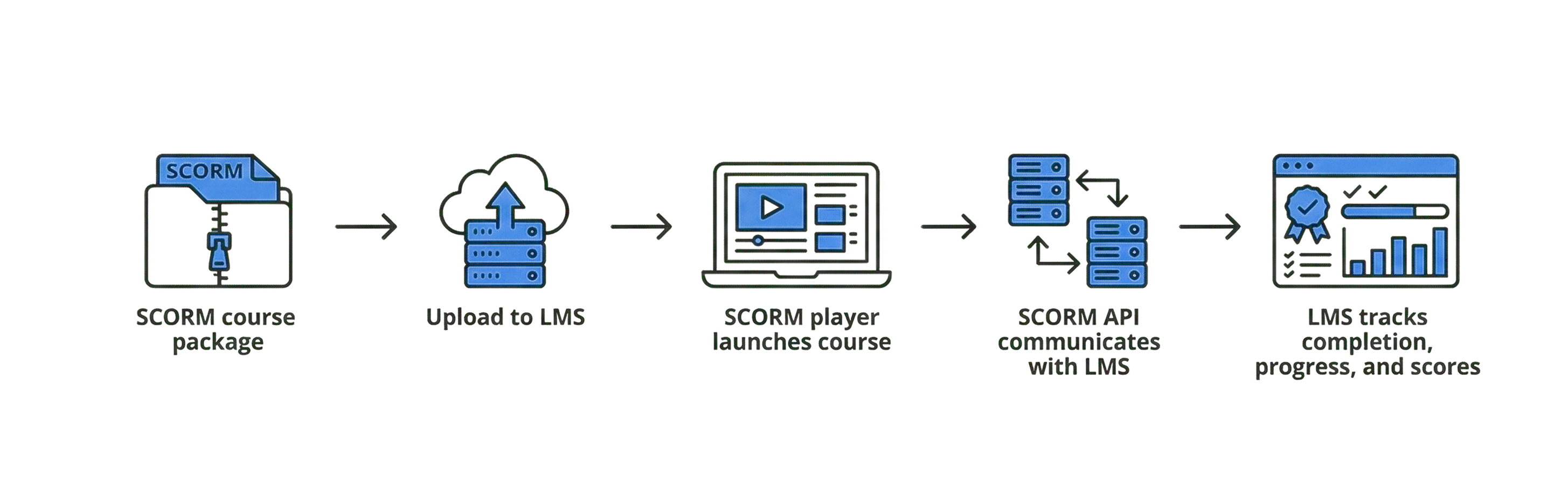
This standardized communication allows SCORM courses to work across multiple LMS platforms, which is why SCORM became the most widely adopted e-learning standard.
SCORM 1.2 vs SCORM 2004 Explained
Two major versions of SCORM are widely used today:
- SCORM 1.2
- SCORM 2004
Both versions enable LMS platforms to deliver and track learning content, but they differ in capabilities.
SCORM 1.2
SCORM 1.2 is the most widely supported SCORM standard.
Key features include:
- Basic progress tracking
- Quiz score tracking
- Completion status reporting
- Simple communication between content and LMS
Many legacy courses are still published using SCORM 1.2 compliant LMS environments.
SCORM 2004
SCORM 2004 introduced several improvements over SCORM 1.2.
Key features include:
- Advanced sequencing rules
- More detailed learner tracking
- Improved navigation logic
- Expanded data reporting
Some organizations specifically look for SCORM 2004 compliant open source LMS platforms when they need advanced course sequencing and reporting.
| Feature | SCORM 1.2 | SCORM 2004 |
|---|---|---|
| Release year | 2001 | 2004 |
| Industry adoption | Most widely supported | Less common but more advanced |
| Progress tracking | Basic completion and score tracking | Advanced progress tracking |
| Course sequencing | Limited | Supports complex sequencing rules |
| Navigation control | Basic navigation | Advanced navigation and sequencing |
| Reporting capabilities | Standard data reporting | More detailed learning data |
| LMS compatibility | Supported by almost all SCORM LMS platforms | Supported by fewer but modern LMS platforms |
Why Organizations Use SCORM Compliant LMS Platforms
Many training organizations ask: why use a SCORM compliant LMS?
The answer lies in interoperability and standardization.
SCORM allows learning content to be reused across different LMS platforms without rebuilding the course each time.
Organizations use SCORM compatible LMS platforms for several reasons.
Content portability
SCORM packages can be moved between LMS platforms easily.
This prevents organizations from being locked into a single LMS vendor.
Standardized tracking
SCORM allows LMS platforms to track learner progress, assessment scores, completion status, and learning time.
This data is important for compliance training and certification programs.
Compatibility with authoring tools
Most popular authoring tools export courses as SCORM packages.
Examples include:
- Articulate Storyline
- Adobe Captivate
- iSpring Suite
- Lectora
A SCORM compatible learning management system ensures that these courses work correctly.
Widely adopted industry standard
SCORM remains one of the most widely adopted e-learning standards.
According to Research and Markets, the global LMS market is expected to exceed $40 billion by 2029, and SCORM remains a foundational standard used in many corporate training systems.
When Should You Use a SCORM LMS?
Organizations often wonder when to use a SCORM compliant LMS.
A SCORM LMS is useful in several situations.
- Corporate training programs – Companies delivering employee training often use SCORM content created by instructional designers.
- Compliance and certification training – Industries such as healthcare, finance, and manufacturing rely on SCORM tracking to verify course completion.
- Training providers and academies – Professional training companies frequently purchase SCORM courses from content vendors. A SCORM LMS for training providers allows them to host and track these courses.
- Large-scale course distribution – Organizations that distribute learning programs to multiple partners or learners often rely on SCORM compatible LMS platforms to standardize course delivery.
What to Look for in a SCORM Compliant LMS
Choosing the right SCORM compliant LMS requires evaluating several capabilities.
SCORM version support
The LMS should support both SCORM 1.2 and SCORM 2004.
Some platforms only support SCORM 1.2, which may limit advanced tracking.
SCORM package upload
A good LMS should allow easy uploading of SCORM course packages without requiring technical configuration.
SCORM player compatibility
The LMS must include a reliable SCORM player to launch and run courses correctly.
Detailed learning analytics
The LMS should track SCORM data such as completion status, quiz scores, progress percentage, and learning time.
These insights help training teams measure learning outcomes.
Integration capabilities
Modern LMS platforms often integrate SCORM learning with learning analytics dashboards, reporting systems, and third-party tools through LTI integrations.
For organizations delivering professional training, choosing a modern SCORM compliant LMS that also supports advanced learning features can make a significant difference.
Platforms like Blend-ed AI LMS combine SCORM compatibility with tools designed for training providers, academies, and enterprise learning teams. This includes support for SCORM course packages, analytics dashboards, AI-powered course creation, and scalable learning infrastructure built on Open edX.
Book a demo to see how Blend-ed supports SCORM training programs
Are All LMS Platforms SCORM Compliant?
One common question is: Are all LMS platforms SCORM compliant?
The answer is no.
Many LMS platforms support SCORM, but not all do.
Some platforms are designed primarily for video courses, simple learning modules, or course marketplaces. These platforms may not support SCORM packages.
For organizations using SCORM-based learning content, choosing a SCORM compatible LMS is essential.
Which LMS Systems Support SCORM?
Several LMS platforms support SCORM packages.
For example: enterprise LMS platforms, open source LMS platforms, and corporate training LMS platforms.
Some modern platforms built on Open edX, such as Blend-ed, support uploading and tracking SCORM 1.2 and SCORM 2004 packages while also integrating modern learning features like AI tutoring and learning analytics.
A SCORM compliant LMS built on Open edX can provide both SCORM compatibility and advanced learning platform capabilities.
SCORM vs xAPI: What's the Difference?
SCORM is the most widely used e-learning standard, but newer standards such as xAPI (Tin Can API) have also emerged to address more complex learning scenarios.
Both SCORM and xAPI allow learning platforms to track learner activity, but they differ in how and where learning data is recorded.
SCORM
SCORM tracks learning activity within a learning management system.
Key characteristics include:
- Tracks learner progress inside the LMS
- Uses a browser-based API to communicate with the LMS
- Designed for structured e-learning courses
- Records completion status, quiz scores, and progress
SCORM works best when learners complete courses within a single LMS environment.
xAPI (Tin Can API)
xAPI was developed to track learning beyond traditional LMS environments.
Key characteristics include:
- Tracks learning across multiple platforms and devices
- Records learning activities outside the LMS
- Uses a Learning Record Store (LRS) to store learning data
- Supports informal learning and real-world learning experiences
For example, xAPI can track learning activities such as simulations, mobile learning, or workplace training events.
Despite the rise of xAPI, SCORM compliant LMS platforms remain the most widely used solution for delivering structured e-learning courses and corporate training programs.
FAQs
What is a SCORM compliant LMS?
A SCORM compliant LMS is a learning management system that supports the SCORM standard, allowing organizations to upload, launch, and track SCORM learning content.
Which LMS platforms support SCORM?
Many enterprise LMS platforms and open source LMS systems support SCORM packages, including platforms built on Open edX and other corporate learning platforms.
Can you upload SCORM courses to any LMS?
No. Only SCORM compatible LMS platforms can properly upload and track SCORM courses.
Is SCORM still relevant today?
Yes. SCORM remains widely used for corporate training, certification programs, and structured online learning.
What is the difference between SCORM 1.2 and SCORM 2004?
SCORM 2004 introduced advanced sequencing and improved tracking compared to SCORM 1.2, which focuses on basic progress and completion tracking.
Can Open edX run SCORM courses?
Yes. Open edX can support SCORM courses using SCORM integration tools or plugins. Platforms built on Open edX, such as Blend-ed Learning Cloud, allow organizations to upload and track SCORM learning packages within the LMS.
Does Blend-ed support SCORM courses?
Yes. Blend-ed AI LMS supports SCORM course packages, including SCORM 1.2 and SCORM 2004 content. Training providers and organizations can upload SCORM courses created with tools like Articulate or Captivate and track learner progress, completion status, and assessment scores within the platform.
Conclusion
A SCORM compliant LMS allows organizations to deliver standardized e-learning content while tracking learner performance effectively.
For training providers, enterprises, and educational institutions, SCORM compatibility ensures that learning content created using authoring tools can be delivered consistently across different LMS environments.
As organizations continue to expand digital learning programs, selecting a SCORM compatible learning management system remains an important decision for delivering scalable and trackable online training.
If your organization already uses SCORM courses created with tools like Articulate, Captivate, or iSpring, using a platform that fully supports SCORM 1.2 and SCORM 2004 is essential for accurate tracking and learner reporting.
Blend-ed AI LMS is a modern LMS built on Open edX that supports SCORM packages while also providing advanced learning tools such as AI tutors, course creation tools, and analytics dashboards.