Blend-ed vs Arlo for training providers.
Blend‑ed is an alternative to Arlo Training Management Software for training providers. Arlo runs your training operations and charges extra for e‑learning. Blend‑ed is an AI LMS with training management built in, so you get both in one platform, with rubric marking and contact hours built for accredited training.
Every Arlo fact comes from arlo.co and Arlo’s help center, last checked 20 October 2026.
Training providers and organizations already running on Blend‑ed

Risknowlogy, a functional safety training provider in the Netherlands, runs its cohorts, priced enrollment options and payments on Blend‑ed, and moved over in weeks.
Blend-ed vs Arlo: the short answer.
Choose Arlo if
Your business runs on scheduled and classroom courses
You want to see prices without a sales call
Online learning is a small part of what you sell

Choose Blend-ed if
You take online training as seriously as classroom training
You assess learners against a rubric
You issue certificates that expire and have to be renewed
or
Both do this
Course scheduling, trainers and venues, bookings and waitlists, a checkout, corporate client portals and invoicing.
If you only need those, either will work.
Blend-ed vs Arlo at a glance.


Arlo
What it is
An AI LMS
with training management built in
A training management system (TMS)
Built for
Companies whose business is training
online, live and in the classroom
Training providers

Learning
Arlo
E-learning and SCORM
Included
with SCORM and H5P
Add‑ons
authoring $99 a month, SCORM $99 a month plus $0.50 per enrollment, $149 for both
AI
AI course creator, tutor and administrator, and an MCP server
Drafts courses from your documents for your experts to approve, tutors inside lessons, and connects the AI assistant your team already uses
Authoring only
course generation, document conversion, images. No learner‑facing AI documented
Programs and paths
Courses, live and classroom sessions and exams in one program
sold as one product, with unlock and completion rules
Bundles
group courses for sale in a set order. Prerequisites and gating not documented
Learner mobile app
Your own branded app
on iOS and Android, with reminders and offline video, as an add‑on
Instructor app only
Learners use a responsive web portal

Assessment and certification
Arlo
Assessment
Assignments and practicals graded against a rubric
by an assessor and checked by an internal verifier, plus quizzes and exams
Quizzes
with a result and grade recorded against the registration. Rubrics, assessor marking, internal verification and portfolios not documented
Attendance
Automatic
from live online sessions, QR check-in in classrooms, and time on self‑paced courses
Automatic
from their video meeting integration, or marked by the trainer. Arlo’s help center says attendance can’t be recorded for e‑learning registrations
Learning hours
Counted from attendance
and usable as a completion and certificate requirement
A fixed number
of points and hours per course, shown on certificates and in reports. Arlo’s help center says it follows completion status, not attendance or grade
Certificates
Issued when learners meet your rules
with expiry, renewal reminders and recertification, one‑click LinkedIn sharing, and Credly or Accredible badges
Templates and expiry tracking
automated renewal reminders, recertification rules and a public verification search
Skills
A skills taxonomy
a skill passport for each learner, and skill gaps by role for corporate clients
No skills or competency framework documented
Audit evidence
An audit trail of every change
from day one, read‑only auditor access, and exports
Read‑only users
on the Enterprise plan. An audit trail of changes is not documented

Operations and commerce
Arlo
Corporate client portals
Yes
A branded portal for each client to buy seats, enroll employees, book sessions and track progress
Yes
Arlo’s Organization Portal launched in May 2026
Selling and checkout
Storefront or your own website
Stripe, Razorpay, PayTabs and Geidea; guest checkout, coupons, subscriptions, regional prices, and company orders on invoice
Deeper on finance
Four gateways plus Apple Pay, Google Pay, Klarna and Afterpay, deposits and part‑payments, credit notes, two‑way Xero sync
Integrations
API and webhooks
a headless storefront, an MCP server, single sign‑on (SAML and OpenID Connect), calendars, and Credly and Accredible
Around 40 listed apps
many of them through Zapier, and 3,000 more via Zapier. Public API, webhooks and SAML single sign‑on

Price
Arlo
Pricing model
Tiered by monthly active learners
quoted per customer
Per administrator license
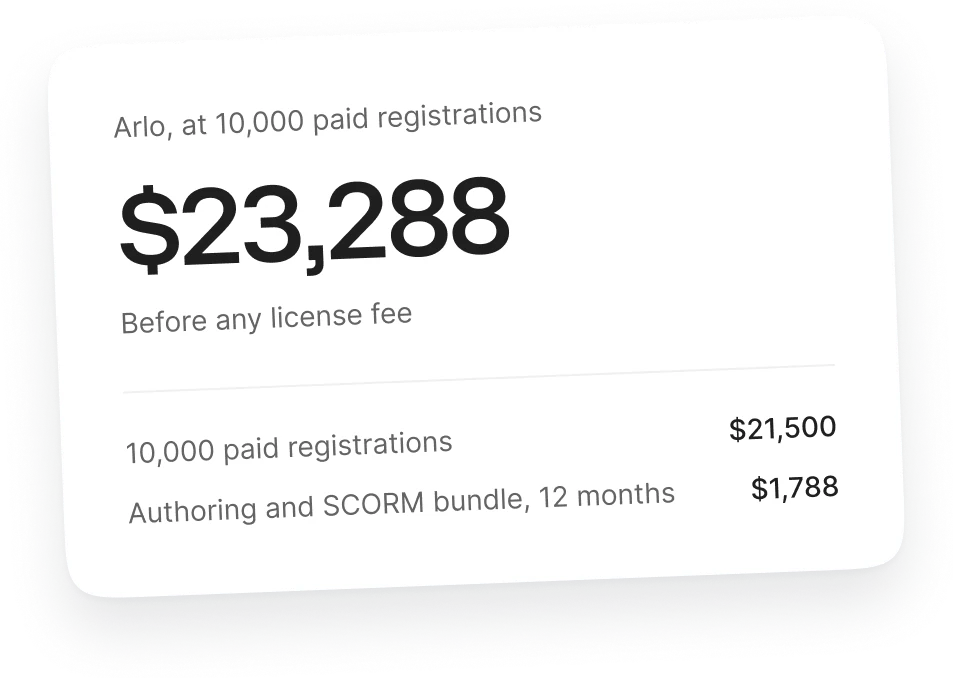
a month, plus $2.15 per paid registration and $1.07 per free one
“Not documented” means it isn’t on Arlo’s published pages, not that Arlo can’t do it.
In one line:
Arlo runs the training operation and sells e‑learning as an add‑on. Blend‑ed runs the operation and the learning in one platform, and goes further on assessment, attendance hours and skills.
How much does Arlo cost?
As of October 2026, Arlo charges per administrator license: $132, $227 or $302 a month, with a Scale plan priced on request. The license rate drops as you add licenses. Registration fees don’t: Arlo charges $2.15 for every paid registration and $1.07 for every free one. Course authoring and SCORM cost $99 a month each, or $149 for both. To estimate your own Arlo bill, multiply last year’s paid and free registrations by those fees, then add licenses and add‑ons.
Blend‑ed is tiered by monthly active learners, as a ceiling on capacity, with no fee per registration. Authoring, SCORM, assessment and certificates are included. For a fair comparison, ask both vendors for a year’s quote at your real volume.




How do Blend-ed and Arlo count contact hours?
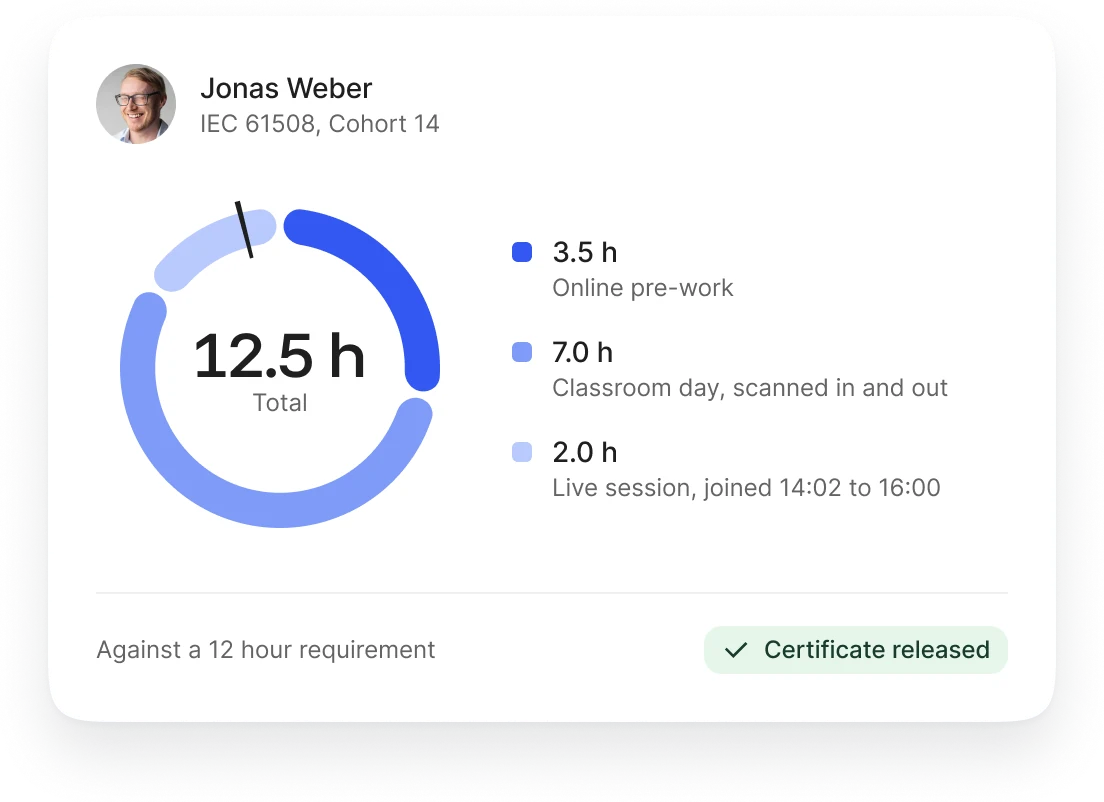
Awarding bodies want contact hours, backed by attendance, for each named learner. Arlo records attendance for live sessions, through its video meeting integration or marked by the trainer. It gives each course a fixed number of points and hours, shown on the certificate and in reports. But Arlo’s help center says those hours follow completion status, “not the attendance or grade”, and that attendance can’t be recorded for e‑learning registrations.
Blend‑ed counts hours from attendance minutes in live and classroom sessions and from time on self‑paced courses. You can hold a certificate until the hours are met, so the evidence and the certificate come from the same record.
How do Blend-ed and Arlo decide an assessment result?
For providers who answer to an awarding body, this is the dividing line. Arlo is strong on the certificate: expiry tracking, automated renewal reminders, recertification rules and a public verification search. How a result is decided is thinner on Arlo’s published pages: quizzes, plus a result and grade typed against the registration. Rubrics, assessor marking, internal verification, portfolios and practical observation don’t appear on the Arlo pages we reviewed in October 2026, and Arlo’s exam page covers scheduling exams, not assessing them.
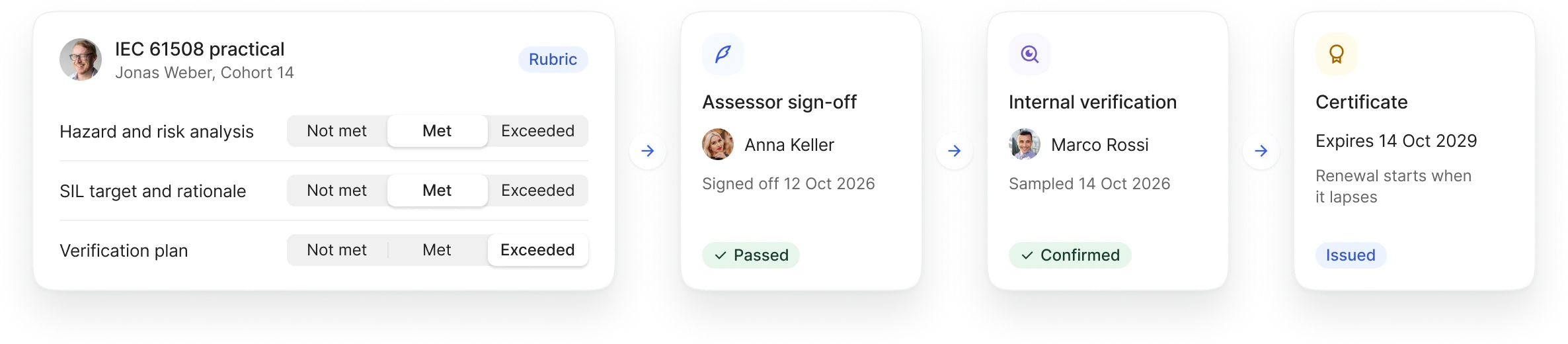
Blend‑ed grades exams, assignments and practicals against a rubric set for a course or program. Assessors mark and sign off the work, and an internal verifier reviews it before results are final. Blend‑ed tracks every certificate’s expiry and starts the renewal when one lapses.


What to check in any demo.
Whichever platform you choose, ask to see these on one of your own courses:
A learner’s hours from e‑learning, live and classroom sessions, added up on one record.
A certificate held back until those hours are met.
An assessor marking a practical against your rubric, and an internal verifier checking the marking.
Your cost for a year at your real number of registrations or active learners.
Where Arlo goes further.
Three areas where Arlo goes further today, and what Blend‑ed does instead.
Scheduling and operations
Arlo has more scheduling tools: room availability at booking, presenters’ time off, catering and room setup, and a confirmation checklist for each course.
Blend‑ed covers dates, venues, trainers, waitlists and run‑or‑cancel decisions, then keeps the course, assessment and certificate on the same record.
Finance and payments
Arlo takes more ways to pay, including Apple Pay, Google Pay, Klarna and Afterpay, with deposits, part‑payments and two‑way Xero sync.
Blend‑ed takes payment through Stripe, Razorpay, PayTabs or Geidea, with coupons, subscriptions, regional prices and company orders on invoice.
Published pricing
Arlo lists its prices publicly.
Blend‑ed quotes each customer, in tiers by monthly active learners, with no fee per registration.
Looking for an Arlo training software alternative?
Here is how a move from Arlo to Blend‑ed works.
Arlo
Blend‑ed
1
Blend‑ed runs the migration, not your team.
Risknowlogy was running on Blend‑ed within weeks of leaving its previous platform.
2
Your records come across.
Learner records and training history move with you.
3
Run both while you switch.
Arlo keeps running alongside Blend‑ed while the move happens.
Questions providers ask us about Arlo.
What does Arlo offer training providers?
Arlo is a training management system. It schedules courses, trainers and venues, takes bookings with waitlists, sells seats through a checkout, and runs corporate client portals and invoicing. E‑learning authoring and SCORM are paid add‑ons. Blend‑ed does the same operations, with courses, assessment and certificates built in.
Is Blend‑ed cheaper than Arlo?
There’s no like‑for‑like number, because Blend‑ed doesn’t publish prices. Arlo charges per license and per registration, so its cost follows your registrations. Blend‑ed is quoted per customer, in tiers by monthly active learners, with no fee per registration. Ask both for a year’s quote at your real volume.
Does Blend‑ed schedule courses as well as Arlo does?
No. Arlo is deeper here. Blend‑ed schedules dates, venues and trainers, runs waitlists and handles run‑or‑cancel decisions. Arlo adds room availability at booking, presenters’ time off, external resource bookings, catering and room setup, and a course confirmation workflow. Blend‑ed adds everything after the booking: the course, assessment, attendance and certificate on one record for each learner.
We already use Arlo. What would we actually gain?
Three things. Assessment beyond quizzes: assignments and practicals marked against a rubric and checked by an internal verifier. Learning hours counted from attendance, with certificates held until they’re met; Arlo awards a fixed number of hours on completion. And a skills taxonomy with a skill passport, which Arlo doesn’t document.
Does Arlo support rubric marking or internal verification?
Not according to Arlo’s published pages. Arlo documents quizzes, plus a result and grade recorded against the registration. Rubrics, assessor marking, internal verification, portfolios and practical observation don’t appear on the Arlo pages we reviewed in October 2026, and Arlo’s exam page covers scheduling exams. Blend‑ed grades assignments and practicals against a rubric, with assessor sign-off and an internal verifier reviewing the work before results are final.
Can Arlo track attendance for e-learning?
No. Arlo’s help center states that attendance can’t be recorded for e‑learning registrations. Arlo records live online attendance through its video meeting integration, and trainers can mark it in the mobile app. Blend‑ed records attendance from live sessions, classroom check-in and time on self‑paced courses, and counts all three as learning hours.

See your own course in Blend-ed before you decide.
Bring a course you run today. We’ll show you how it runs in Blend‑ed, and tell you where Arlo would serve you better.