
Key Takeaways
Who is this guide meant for?
Training companies and certification bodies delivering compliance courses to external clients in regulated industries. Not internal L&D teams.
What industries this guide include?
Medical device (ISO 13485, IEC 62304, EU MDR), functional safety (IEC 62443, IEC 61508), pharma and life sciences (GMP, Part 11, Annex 11), and quality management (ISO 9001, IRCA).
What changed in 2026?
The FDA's Quality Management System Regulation took effect on 2 February 2026, folding ISO 13485:2016 into 21 CFR Part 820. US device manufacturers are now inspected to requirements aligned with ISO 13485, which raises the evidence bar for the training companies that serve them.
Why cannot a basic LMS do that?
Regulated compliance training includes audit-ready records, cohort management, multi-client portals and certificate workflows. Basic platforms were not built for any of these.
Which platform is made for training companies?
Blend-ed. It is the only platform in this comparison that's designed from the ground up specifically for professional training companies selling courses to external clients.
What do you check for first in a demo?
Multi-client portals, automated certificate issuance with expiry tracking and audit ready reporting. If a platform doesn't display all three live, it's not suited to your use case.
The main reason for organisations around the world to adopt an LMS is compliance, as stated by 73% of organisations. Most platforms on that list were built to host one company's internal training, not to sell certified courses to dozens of external clients.
That gap matters if you're a training company offering ISO 13485 lead auditor courses, IEC 62304 software lifecycle programs or IEC 62443 cybersecurity certifications. You operate paid cohorts. You serve multiple client companies. Your delegates will sit formal exams and gain certificates that will be examined by notified bodies and certification auditors.
This guide compares seven platforms for that exact buyer: training providers and certification bodies selling compliance courses externally. If you are an internal compliance manager training your own staff then a number of the platforms further down this list, Kallidus and Litmos in particular, were indeed built for you. Beyond the feature comparison, it also covers validated systems, how to size up a vendor at demo stage, and what changes if your clients are in the US or UK.
Why Regulated Compliance Training Needs More than a Basic LMS
A typical LMS monitors course completion. This won't fly when an auditor from a notified body asks for timestamped evidence of IEC 62304 competency for a whole cohort of delegates, or an ISO 13485 certification body needs to validate every delegate passed their assessment before a certificate was issued.
Regulated industries embed their own requirements into the standards. ISO 13485:2016 requires competency assessment to be documented, not just a record of training completion. Article 15 of the EU MDR mandates specific qualifications for the people responsible for regulatory compliance. If you are running IEC 62443 programs through exida or TUV bodies, you need to have audit-ready records that will survive a program review. This is not something a generic LMS was built to produce. It only improves audit readiness if it was designed to manage the evidence trail regulators actually request.
Compliance Training Requirements by Regulated Industries
Training obligations differ across regulated industries. Knowing which standards apply tells you whether a platform can actually support your programmes.
Medical device training includes ISO 13485 (quality management systems), IEC 62304 (medical device software lifecycle), and EU MDR/IVDR regulatory requirements. Training companies like BSI, TUV SUD, and DEKRA run lead auditor and implementer courses here. IEC 62304 training is a growing niche as more medical software products fall under lifecycle compliance.
The regulatory picture shifted in 2026. The FDA's Quality Management System Regulation (QMSR) folded ISO 13485:2016 into 21 CFR Part 820 on February 2, 2026, and the FDA retired its QSIT inspection process the same day. US device manufacturers are now inspected against ISO 13485-aligned requirements. Records like internal audit reports and management reviews are no longer exempt from inspection. That means more demand and a higher evidence bar for training companies running ISO 13485 programmes.
Functional safety training covers IEC 61508 (base standard), IEC 61511 (process industry), ISO 26262 (automobile), and IEC 62443 (industrial cybersecurity). These usually run as multi-day cohorts with formal exams and dual certification from the training company and a certifying body like TUV SUD or exida. For a deeper look at this segment, see our functional safety LMS comparison.
Pharma and life sciences training covers GMP under 21 CFR Parts 210 and 211, electronic records and signatures under 21 CFR Part 11, and EU GMP Annex 11 for computerised systems. Data integrity gets assessed against ALCOA+ (attributable, legible, contemporaneous, original, accurate, complete, consistent, enduring, available). Training companies serving pharma manufacturers, CMOs, and QA/QC contractors deliver GMP awareness, deviations and CAPA, and computer system validation as certified programmes. Treat this evidence bar as a moving target: the EU's Annex 11 is mid-revision as of 2026, with a new AI-specific annex in the works.
Quality and management systems training includes ISO 9001, ISO 14001, ISO 45001, and ISO 27001, including IRCA-registered lead auditor programmes. These tend to run at higher volumes with shorter course lengths. If you offer these programs, see our ISO lead auditor LMS comparison.
What to Look for in an AI LMS for Regulated Compliance Training
There are six features that separate a capable compliance training LMS from a generic one. Certificate tracking is where most buyers begin, but that's just the start.
Multi-cohort administration
Run the same programme several times a year with different delegates, start dates and client companies without having to re-build the course each time.
Audit-ready reports
Export of completion records with timestamps, assessment scores, attendance logs and certificate issuance history in a format suitable for regulatory review.
Certificate issue and expiry tracking
Certificates expire in regulated industries. The platform should automate expiry notifications and re-enrolments.
Multi-client portals
Each client company only sees its own delegates and certificates. A properly configurable LMS manages this through multi-tenancy or white-label sub-portals.
Designing AI courses
Develop structured course content from standards documents and SOPs to reduce the time spent developing courses before each new programme or revision cycle.
SCORM compliant
The majority of the regulated training content is delivered in SCORM packages. The LMS must support both SCORM 1.2 and SCORM 2004.
What is a Validated LMS? When Do You Need One?
A validated LMS has proof it works the way it should. That proof comes from three steps. People call them IQ, OQ, and PQ. These are short for installation, operational, and performance qualification. Training companies usually follow a framework like GAMP 5 to do this. The platform also has to meet certain rules. In the US, that means 21 CFR Part 11 for electronic records. In Europe, it means EU GMP Annex 11 for computer systems.
Not every compliance training programme needs a validated LMS. You need one when the LMS becomes part of your client's quality system. This usually happens because an auditor will check the training records your LMS creates. Sometimes a notified body checks instead. In this comparison, that's Dokeos. It was built with a validated setup. That setup is for training companies whose clients work in pharma, medical devices, or life sciences.
If your clients don't ask for validation documents, you don't need this extra work. A standard, audit-ready LMS with strong reporting, like Absorb or Blend-ed, gives you the same proof without it.
Best 7 AI LMS Platforms for Compliance Training in Regulated Industries 2026
This comparison is relevant for training companies that sell compliance courses to external customers. Each platform is scored on the six features above, plus validated-system depth where applicable.
Jump to a platform: Blend-ed | Kallidus | Dokeos | Absorb LMS | Litmos | LearnUpon | 360Learning
Comparison Table
| Platform | Best For | Audit Trail | Certificate Management | Multi-Client Portal |
|---|---|---|---|---|
| Blend-ed | External training providers | Yes | Yes, with expiration monitoring | Yes, full white label |
| Kallidus | Internal staff compliance and ongoing professional development | Yes | Yes, CPD tracked | Partial |
| Dokeos | Pharmaceutical and medical device training | Yes, validated system | Yes | Partial |
| Absorb LMS | Enterprise compliance reporting | Yes | Yes, with renewal | Partial |
| Litmos | Rapid deployment, compliance libraries | Yes | Yes | Limited |
| LearnUpon | Client and partner multi-portal training | Yes | Yes, with recertification | Yes, multi-portal |
| 360Learning | Internal compliance collaboration | Yes | Yes, with expiration tracking | Partial, group-based |
How Did We Assess These Platforms?
Blend-ed published this comparison, so here's the standard we held ourselves to. All of the below claims were checked against official vendor documentation. If we couldn't verify it, we don't include it, rather than guessing. The Blend-ed entry is one of those cases. The evaluation criteria are presented in the features table above. We did not apply numerical scores or weightings to platforms due to the lack of public documentation to support that level of granularity. The order of the platforms is a reflection of fit for training companies serving regulated industries and should not be interpreted as a ranking of all platforms. Prices and features are subject to change, so make sure to confirm on the official vendor pages before you buy.
1. Blend-ed
Product Overview
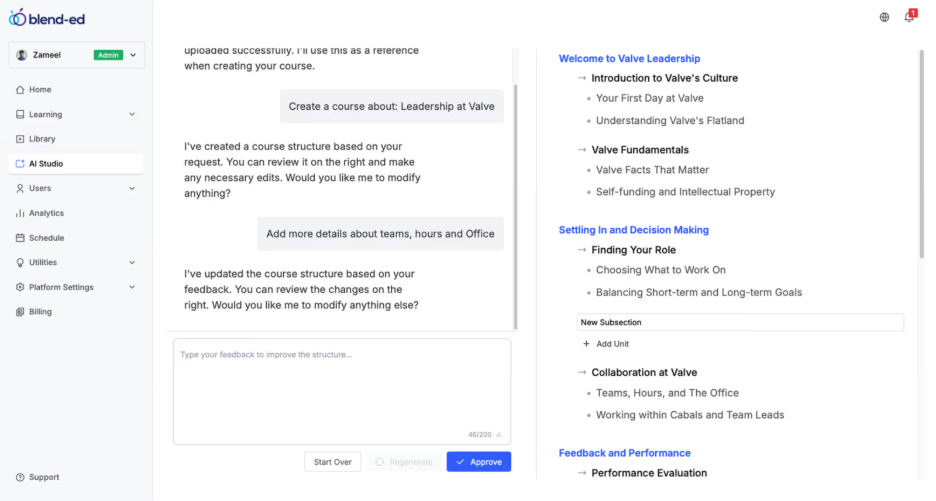
Blend-ed is an advanced AI LMS for professional training companies, based on Open edX, where it is one of the 13 official global partners. It brings authoring, delivery and certification into one system, designed for organisations selling compliance courses to external clients, not internal HR teams, with true multi-tenancy and AI built into the platform, not added on as an isolated feature. Pricing is on the pricing page, and they offer a free trial.
Key Features
- AI Course Creator - structured courses from standards documents, PDFs and SOPs
- AI Tutor is available to delegates between sessions; AI Admin manages enrolment, reminders and recertification
- Skill Passport and AI skill gap detection map delegate progress to named competencies, supporting documented-competency requirements such as ISO 13485
- Multi-client portals with individual branding, delegate records and compliance status per client
- Cohort management with set start dates, attendance tracking and exam workflows
- Automated certificate issuance with expiry tracking and re-enrolment triggers
- Full white label with custom domain and mobile app, plus SCORM support
- Ecommerce built in to sell courses and certificates
Best For
- Training companies providing certified compliance programmes to external clients
- Professional academies offering ISO 13485, IEC 62304, IEC 62443 or ISO 9001 programs
- Multi-client training providers with individual portals for each corporate client
- Companies requiring audit-ready records for notified body or regulatory review
Pros
- Built for external training companies, not a corporate L&D tool repurposed for the purpose
- AI is able to generate content, assist delegates and automate admin tasks
- Multi-client architecture is native, not a configuration hack
Limitations
- No pre-built compliance content library; bring your own content or create it yourself with the AI Course Creator
- Better for structured training organisations than solo course creators
Verdict
Blend-ed is the only platform here that has been specifically designed for companies running certification programmes for external delegates. Useful when cohorts, client separation and audit trails are all important. Skip if you just need to host a few internal courses.
Sources checked
homepage, product page, pricing page.
2. Kallidus
Product Overview
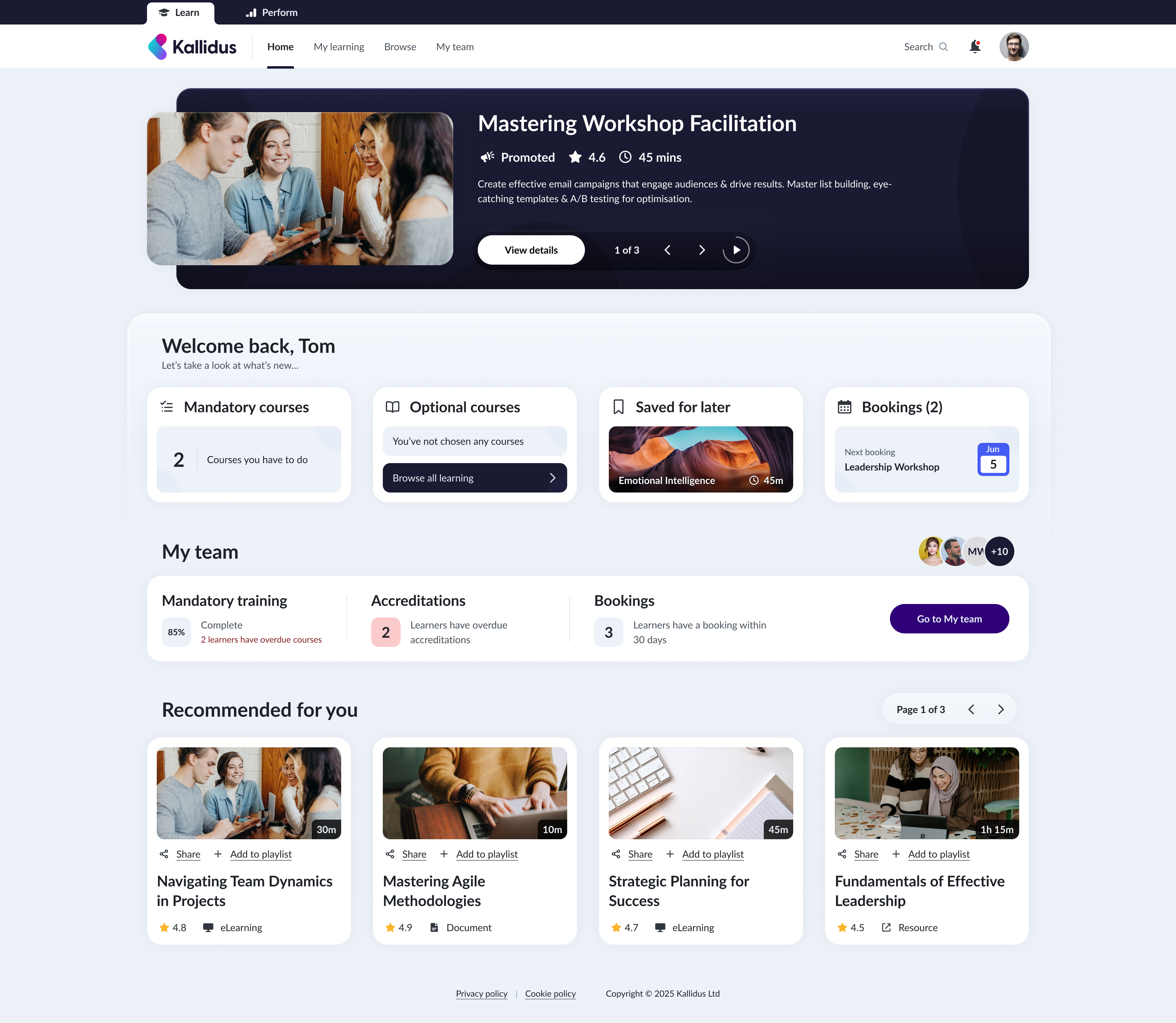
Kallidus is a compliance-focused LMS built for internal workforce training, not for delivering external commercial certifications. It blends LMS capabilities with compliance management, CPD management and pre-built course libraries and is used by many healthcare, financial services, retail, manufacturing and professional services organisations to deliver mandatory training. Pricing is quote-based.
Key Features
- Compliance tracking with automatic reminders and required training workflows
- CPD management and certificate tracking
- AI-assisted learning with configurable governance controls
- Manager dashboards and integrated performance management
- Built-in analytics with integration with Power BI
- Off the shelf compliance content library and SCORM compatibility
Best For
- Enterprise organisations that manage internal compliance and workforce development
- Companies needing mandatory training, CPD tracking and audit reporting
- Finance, healthcare, manufacturing and retail with compliance requirements
Pros
- Solid monitoring and reporting on compliance with embedded analytics
- Integrated performance management beyond a traditional LMS
- Large library of off-the-shelf compliance content lowers authoring workload
Limitations
- Not intended for third-party training providers who sell certification programmes
- Limited multi-client segregation and white label capability
- Governance over AI capabilities, rather than AI native
Verdict
Kallidus is strong for internal workforce compliance with built-in performance management and it earns its place for enterprise mandatory training at scale. But it is not designed to deliver certified programmes to external commercial clients.
Sources checked
3. Dokeos
Product Overview
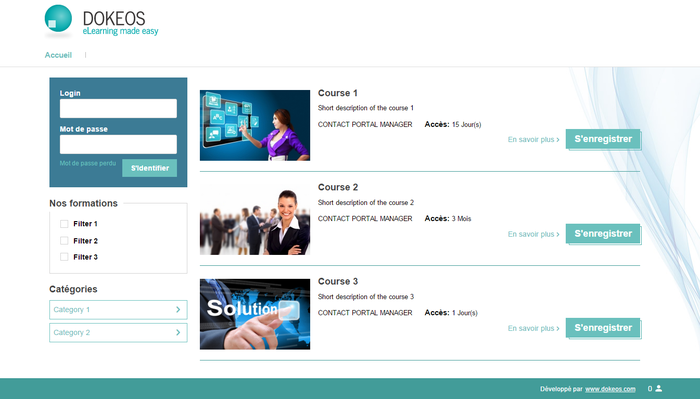
Dokeos is a compliance-first LMS for pharma and healthcare training with a validated system architecture that meets 21 CFR Part 11 requirements for electronic records and electronic signatures. It is intended for organisations where the training platform itself needs to be validated against regulation. Pricing is quote-based.
Key Features
- Validated system design compliant with 21 CFR Part 11
- Support for electronic records and signatures
- Audit trails built into the core system design
- Course delivery and compliance course tracking
- Tools for reporting on regulatory inspections
Best For
- Training companies for pharma and medtech manufacturers
- Organisations needing a validated training platform as part of their own QMS for their customers
- Electronic signature and records validation programmes
Pros
- Compliance-first design, not a compliance module bolted on later
- Audit trail depth suited to pharma and life sciences requirements
- Credible option where 21 CFR Part 11 validation is non-negotiable
Limitations
- Limited AI capability; content creation relies on traditional authoring tools
- Multi-client portals are partial, not suited to managing many separate client academies
- Not designed for commercial certification programs at scale
Verdict
Dokeos is the right choice if your training company specifically serves pharma or life sciences clients who need a validated LMS with electronic signature support, and with the FDA QMSR in force since February 2026, that segment is getting busier. For any other regulated industry the feature set is thin and the validation overhead isn't needed.
Sources checked
4. Absorb LMS
Product Overview
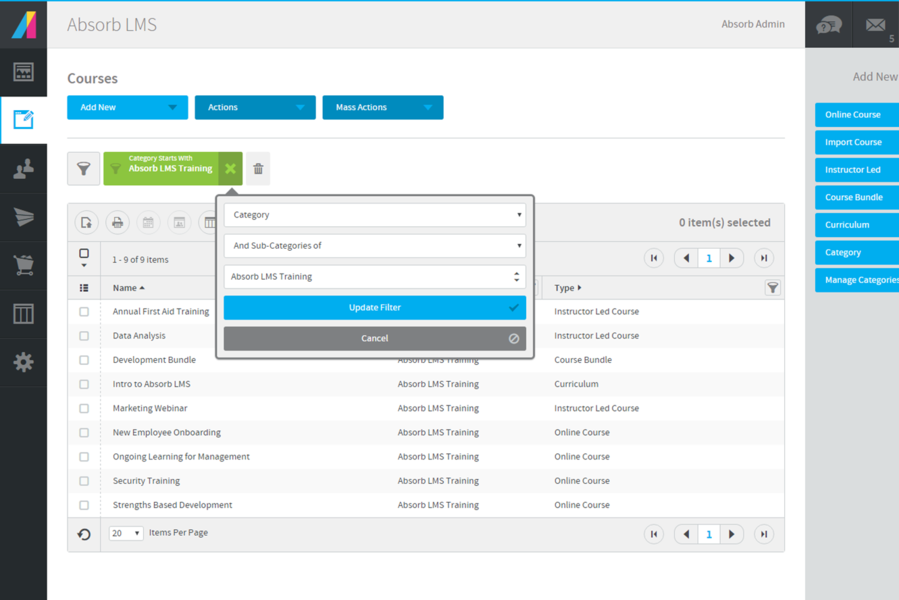
Absorb LMS is an enterprise compliance LMS with strong reporting and certification lifecycle management. It includes “Absorb Intelligence” for enrolment and compliance automation. It is designed for organisations with large-scale internal compliance training programmes. Pricing is quote-based.
Key Features
- Dashboards for compliance reporting and advanced analytics
- Expiration monitoring and automated recertification workflows
- Audit-ready reports to demonstrate compliance
- Absorb Intelligence for enrolment automation
- Ecommerce functionality and white label options
- ILT scheduling with digital course delivery
Best For
- Compliance training operations where detailed analytics and evidence trails are the priority
- Organisations handling a large number of delegates from one client base
- Training companies selling to extended enterprise clients that have reporting requirements
Pros
- Mature and well-developed certification lifecycle management
- Reporting depth is one of the strongest here
- Works well with high numbers of delegates
Limitations
- AI capability is limited compared to AI-native platforms
- Multi-tenancy for several external client companies requires significant configuration
- Not natively designed for the commercial training company model
Verdict
Absorb is the strongest option on this list for depth of compliance reporting, and that's why you should shortlist it if your training business runs on audit evidence and certification analytics. The case for multi-client delivery is not as strong.
Sources checked
5. Litmos
Product Overview
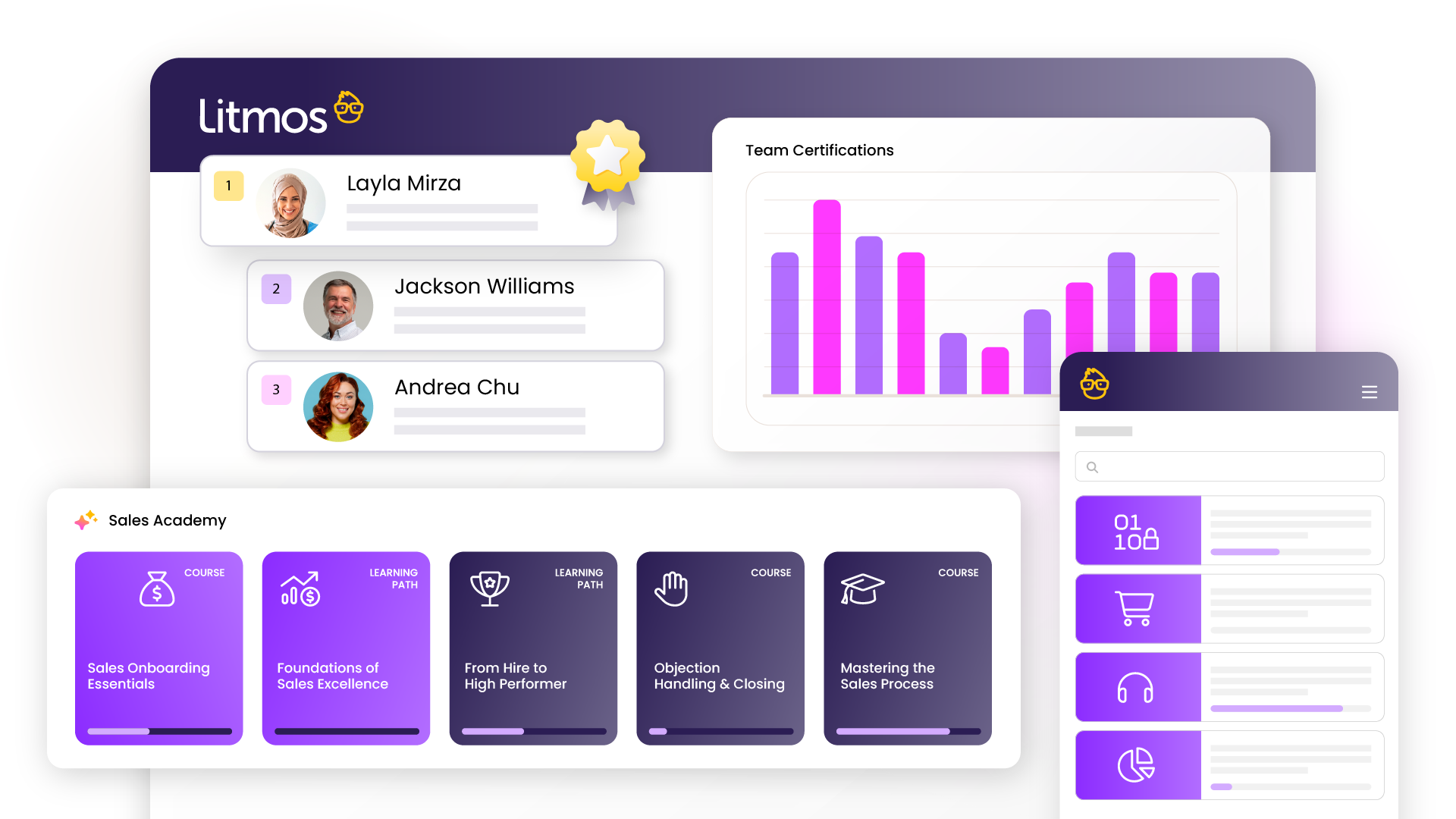
Litmos is a cloud-based LMS for fast deployment compliance training, and has been an independent company under Francisco Partners since December 2022 when SAP sold the business. It's known for a large library of pre-built content for compliance and automation workflows, designed for internal corporate training at scale. Quote-based pricing.
Key Features
- Compliance content library pre-built across multiple regulatory topics
- Automated workflows for enrolment, reminders and recertification
- Dashboards for monitoring and reporting compliance
- Minimal setup time, rapid cloud deployment
- Integration with SAP SuccessFactors and other enterprise systems
Best For
- Training companies that need to quickly roll out off-the-shelf compliance content
- Single client organisations rather than multiple external organisations
- Teams requiring SuccessFactors and enterprise system integrations
Pros
- A large content library lessens the burden to create an initial course
- Less complex platform to deploy than more configurable platforms
- Strong compliance monitoring for simple programmes
Limitations
- For internal corporate training only; not for external client delivery
- Multi-client portals for separate client companies are not a native feature
- The AI is limited to simple automation and cannot produce content or learn in an adaptive way
Verdict
If your training company is looking for a quick start, pre-built content and no need for complex multi-client or certification lifecycle workflows, Litmos is a good fit.
Sources checked
6. LearnUpon
Product Overview
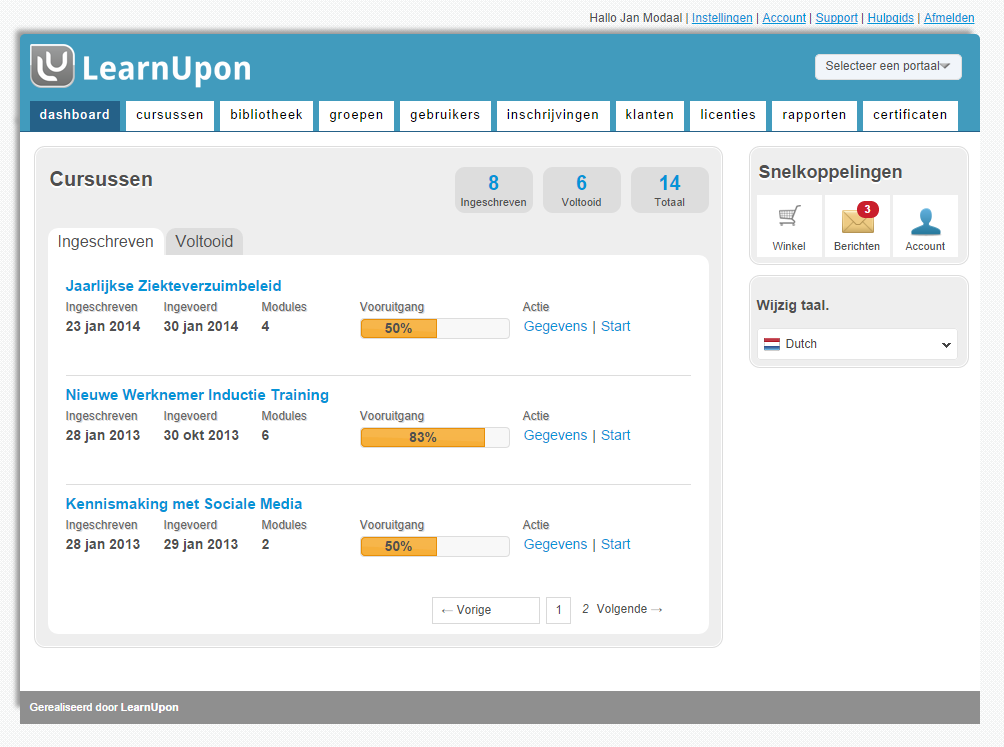
LearnUpon is a cloud-based LMS focused on multi-portal delivery. Organisations run separate branded training portals for employees, customers, partners or client companies from one admin console, each with its own users, content and reporting. A Dublin-founded platform used by more than 1,000 businesses for compliance, certification and customer training. Pricing is quote-based, with minimum contract sizes suited to mid-size and larger operations.
Key Features
- Multi-portal architecture, unique branding, users and reporting per portal
- Certificates with expiry dates and automated re-enrolment for recertification
- Dynamic group rules for auto-enrolment by role, team or customer
- SCORM and xAPI support enables completion rules to be modified without re-writing content
- Policy and compliance sign-off e-signature and acknowledgment workflow
- 60+ integrations including two-way Salesforce sync
Best For
- Organisations training different audiences with each needing a branded portal
- Training providers whose corporate clients want their own environment and reporting
- Teams operating compliance programmes alongside customer and partner education
Pros
- Native and proven multi-portal delivery, not a configuration hack
- Automated recertification handles the entire certificate lifecycle from issuance to renewal
- Good administration with strong support reputation
Limitations
- Newer AI capability, lighter than AI-native platforms; no AI tutor or admin agent
- Cohort and formal exam workflows are not as intensive as purpose-built certification delivery
- Small providers can't afford the custom pricing with minimum contract sizes
Verdict
For this comparison, LearnUpon is the strongest multi-portal option and is best suited when your clients each expect a branded environment with separate records and your programmes are not reliant on formal exams and dual certificate issuance. If that's not quite your model, check out our LearnUpon alternatives comparison for other options.
Sources checked
7. 360Learning
Product Overview
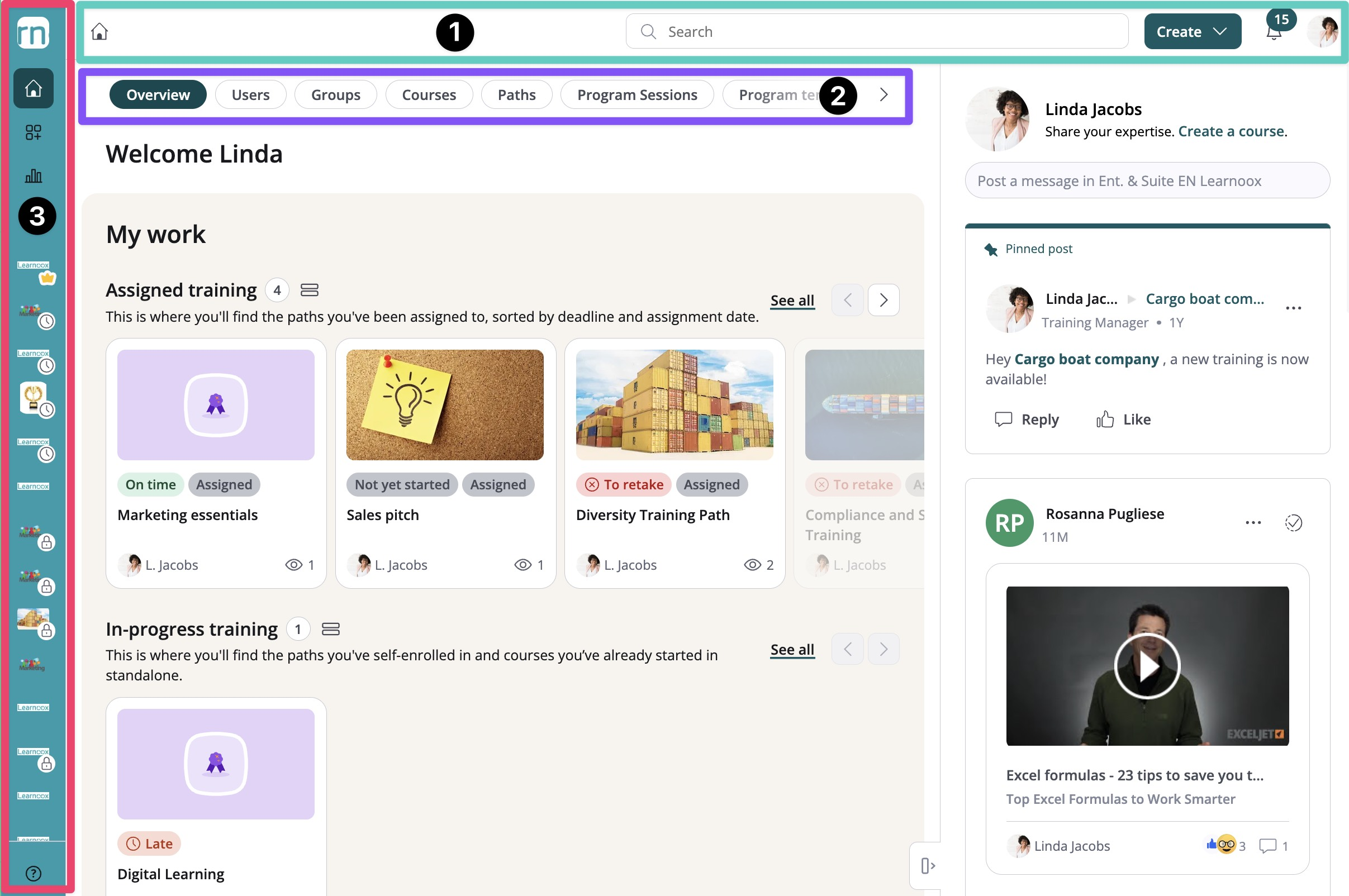
360Learning is an AI-driven enterprise LMS that delivers structured compliance training with automated enrollment, certification management, and audit-trail reporting built for highly regulated environments. While generic platforms force organizations to choose between rigid top-down compliance and agile internal knowledge sharing, 360Learning eliminates this trade-off. It is purpose-built for enterprise and mid-market organizations that want to leverage internal L&D teams and subject-matter experts to scale audit-ready compliance training without increasing administrative headcount.
Key Features
- Converts source documents into interactive compliance courses via a multimodal AI studio while an AI Companion automates bulk admin workflows
- Automates compliance lifecycles with automated enrollment and uses structured prompt management to keep AI content within regulatory boundaries
- Generates timestamped completion records structured for audits alongside smart scheduling and e-signatures for live training
- Isolates and trains internal staff, field entities, and external partners through advanced group structures and role-based permissions
- Provides an ISO 27001 secure infrastructure featuring full REST APIs and robust two-way sync integrations with SAP and Workday
Best For
- Enterprise and mid-market organizations in heavily regulated sectors that need ironclad, audit-ready compliance records
- Organizations that want to decentralize content creation, empowering internal experts to build and maintain training natively
Pros
- Automated certification tracking, expiry notifications, and audit-proof e-signatures natively fulfill rigorous compliance standards
- L&D-controlled prompt templates guarantee that expert-vetted, localized courses (supporting 70+ languages) remain on-brand and compliant
- Advanced group architecture and multi-tenant sub-portals allow for granular visibility controls and secure data segregation between internal business units or external teams
Limitations
- Optimized for organizations scaling a strategic, internal knowledge-sharing culture; less suited for businesses purely reselling generic, off-the-shelf training libraries to external clients
- The deep enterprise feature set and robust compliance controls require intentional setup and internal alignment compared to basic, plug-and-play systems
Verdict
360Learning stands out because it proves that rigid regulatory compliance doesn't require slow, top-down content bottlenecks. By grounding agentic AI and multimodal generation in an organization's proprietary expertise, it keeps content highly accurate, continuously updated, and completely audit-ready at the speed of business.
Sources checked
360Learning security and privacy page, 360Learning compliance training page.
Who Shouldn't Choose Blend-ed?
Not everyone on this list is right for Blend-ed. Skip it if you're just going to host a few internal courses for your own staff, want training fully embedded in an existing HR suite, or don't need multi-client portals, cohorts, certificates, or AI-assisted course creation. That use case would probably be better suited to Kallidus, Litmos or Absorb.
How Do You Screen LMS Vendors for Regulated Industries?
Feature lists don't tell you how well a platform will stand up in front of an auditor. At demo stage, ask for four things:
- Vendor validation documentation pack, if you need one
- Live audit-export test run on your own sample cohort
- Setup time for a second client portal
- Exact records format you get at contract exit
Security certifications matter too, and they change over time and vary by vendor, so check directly on each vendor's current trust or security page, and don't rely on a comparison article. 360Learning lists ISO 27001 and SOC 2 Type II as an example of things to look for on its security page; ask every platform on your shortlist for the same proof, and get commitments in writing before signing. If you're wondering whether you need a dedicated training-operations layer in addition to the LMS, we have a TMS vs LMS comparison that discusses that difference.
Do US and UK Regulated Industries Require a Different LMS?
No, the platform itself does not need to change by country. What changes is the evidence trail your clients expect to see.
In the US, that means training records that hold up under OSHA's safety rules. These are called 29 CFR 1910. This matters most if you train manufacturing clients. It also means meeting the FDA's rules for medical device and pharma training. We covered those rules above: the QMSR and 21 CFR Part 11.
In the UK, it means records that satisfy a few different bodies. HSE checks workplace health and safety. MHRA checks pharma and medical device inspections. IRCA checks lead auditor programmes for ISO 9001, 14001, and 45001. IRCA runs its auditor register through the Chartered Quality Institute.
If you deliver EU MDR programmes, that requirement applies in both markets. It does not matter where your clients are based. The LMS has to create records in the exact format their regulator asks for.
That's why a multi-tenant architecture to keep each client's evidence separate is as important as the content itself.
Other Compliance Platforms Buyers Ask About
A few platforms come up often in compliance LMS searches. They did not make this list. Each one has a clear reason why.
Go1 licenses course content from over 250 providers. It plugs into your existing LMS. It is not a standalone LMS on its own. It works more like a library layer. Acorn is a performance and learning platform built around capability frameworks. It is strong for internal workforce development. But it was not built for external client delivery. Learning Pool combines an LMS and an LXP. It serves large, spread-out internal workforces, especially in the public sector. Skillcast is a UK compliance content specialist. It is strong on FCA and financial services topics. But it is sold as course content plus a lighter LMS, not a full training-delivery platform.
All four solve a real problem. But none of them are built for the training-company model this comparison covers: paid cohorts, multiple client portals, and certificates that outside auditors will inspect.
Choosing the Best Platform for Your Compliance Training Business
Most training companies already have an LMS. The question is not which platform is the best in the abstract. It's whether the cost of staying with the wrong one now is worth the trouble of changing.
Signs Your Current Platform Is Limiting You
You are manually pushing certificates. Clients want their own portal and instead are getting filtered spreadsheets. Your team spends more time managing the LMS than conducting training. An auditor came in and it took three days to pull records. Any one of these is something to note. All four means change is long overdue.
Questions to Ask Before You Commit
What is the onboarding time for companies with pre-existing courses and delegate data? Can SCORM content be migrated without rebuilding? How long does it take to set up a new client portal? What support do you provide in the first 90 days? These questions distinguish vendors who have done this before from ones who are figuring it out with you.
What a Realistic Time Horizon Looks Like
Company onboarding generally takes four to eight weeks and includes configuration, client portal setup, course migration, and team training. A vendor promising faster is worth pressing on what gets skipped.
Conclusion
Regulated industry compliance training isn't a normal L&D job. Delegates sit formal exams. Certificates expire and need renewing. Notified bodies and certification auditors check your records. Your clients want a portal that shows only their own people. Most platforms in this comparison were built for something else first. Think internal workforce training or general enterprise learning. They got adapted later to handle compliance evidence. Most do it well. The real question is simple. Does your business serve external clients? If it does, Blend-ed is the platform for you. That's true if you run paid cohorts, manage multiple client portals, and issue certificates that regulators will inspect. Blend-ed is the only platform here built for that model from day one. The others got fitted to it later. If you keep your training in-house, you have good options too. Kallidus, Absorb, Litmos, 360Learning, and LearnUpon each solve a real piece of that problem well. Which one fits depends on what matters most to you. That could be compliance depth, reporting, fast deployment, letting internal experts build the content, or multi-portal delivery. If you run a training business serving regulated industries, whether that's medical device, functional safety, pharma, or quality management, book a demo and see how Blend-ed fits your delivery model.
Frequently Asked Questions
What is the best AI LMS for compliance training in regulated industries?
It depends whether you train external clients or look after internal staff compliance. Blend-ed is the best fit for companies selling certified programmes externally in medical device, functional safety or quality management. It's the only platform here purpose-built for external delivery, with multi-client portals, cohort management and automated certificates.
Does an LMS need to be audit-ready for ISO 13485 training?
Yes. ISO 13485:2016 requires documented competency assessment, not just evidence of training. The LMS used for ISO 13485 programs should have timestamped completion records, assessment scores and certificate logs for review by a notified body auditor. A platform which only tracks completions is not sufficient where evidence is required for regulatory purposes.
What is the impact of FDA QMSR on LMS requirements for ISO 13485 training?
The Quality Management System Regulation was implemented on 2 February 2026, integrating ISO 13485:2016 into 21 CFR Part 820. The FDA now conducts inspections of US device manufacturers based on ISO 13485-aligned requirements, rather than the discontinued QSIT process. This widens demand and raises the evidence bar for training companies delivering ISO 13485 programmes. Clients will need timestamped competency records they can produce for both FDA and notified body audits.
What is a validated LMS and do I require one?
A validated LMS has documented evidence, created during installation, operational and performance qualification, that it performs as intended under a framework such as GAMP 5. You only need one if your clients' quality system requires validated tooling, usually in pharma or medical device work; otherwise a standard audit-ready platform with good reporting covers the same evidence need.
Can you get IEC 62304 training from a generic LMS?
It can provide the content, but it struggles with the operations around it. IEC 62304 training companies typically provide cohort-based courses, with formal assessments, certificates, and multi-client delivery. These need multi-tenancy, cohort architecture, and structured audit trails, which generic platforms don't support out of the box.
What's the difference between a compliance LMS for training companies vs. an internal L&D team?
An internal compliance LMS delivers training to employees, monitors completions, and reports to HR or a compliance officer. For a training company, a compliance LMS has to be able to run paid cohorts, manage multiple client companies in separate portals, issue certificates to individual delegates, and maintain audit-ready records that regulators and auditors will review. It's a difference in operating model, and no feature list will bridge that gap.
How do compliance training companies in regulated industries benefit from AI?
Three ways. AI course development streamlines the process by using structured content derived from standards documents and SOPs. Between sessions, AI tutors help delegates with questions about the particular standard they are studying. AI admin tools automate enrolment, reminders and recertification, lessening the manual overhead for companies that run multiple cohorts and client accounts simultaneously.