
Best LMS for Functional Safety Training Companies in 2026
Key Takeaways
- Most LMS platforms are built for internal employee training. Functional safety training companies need a platform built for external learners, paid cohorts, and dual-body certificate workflows.
- The six features that matter: multi-cohort management, dual certificate issuance, multi-client portals, pass/fail exam tracking, audit-ready records, and certification expiry with automated re-enrollment.
- Blend-ed is the only platform in this comparison purpose-built for training companies running certification programmes for external learners.
- Docebo is a strong enterprise LMS but not built for TUV dual-certificate workflows or cohort-based certification programme delivery.
- TalentLMS and Absorb LMS are solid corporate L&D tools. Neither is optimised for the IEC 61508, IEC 61511, or ISO 26262 certification lifecycle.
- Totara and Moodle Workplace work well for organisations managing internal compliance training. Neither is designed for training companies selling certified programmes to external clients.
What Makes Functional Safety Training Different from Corporate Training
Most LMS buying guides compare platforms for onboarding, compliance refreshers, and skills development. Functional safety training companies are a completely different buyer.
If you run an approved training programme for TUV SUD, TUV Rheinland, exida, or a similar certification body, your business model does not look like a corporate L&D team. You run multi-day cohort courses (typically 3 to 5 days) covering standards like IEC 61508, IEC 61511, ISO 26262, IEC 62443, or ISO 13849. Your learners are safety engineers, instrumentation specialists, and project managers from industrial companies. They pay between EUR 1,500 and EUR 3,500 to attend. They sit a formal examination. They receive a certificate, often two: one from your company and one from TUV SUD or exida.
That is a certification lifecycle, not a training programme. And a certification lifecycle needs a completely different kind of platform.
The Five Operational Realities That Make Functional Safety Training Different
Dual-body certificate issuance
When a learner passes a TUV SUD-certified IEC 61508 course, they need a certificate from your training company and a TUV SUD FSCP certificate linked to their exam result and experience record. Generic LMS platforms have no concept of this workflow.
Cohort-based delivery with formal examination
IEC 61511 courses, LOPA Facilitator programmes, and Functional Safety Management training run as structured cohorts with fixed start dates, mandatory attendance tracking, and examination management. Most LMS platforms are built for self-paced e-learning, not cohort delivery.
Multi-client portals
Functional safety training companies typically serve corporate clients who send multiple engineers to each cohort. Each client needs a separate portal showing only their own learners, their own certificates, and their own compliance status.
Audit-ready records for certification body reviews
TUV body programme audits and IRCA reviews require specific evidence: timestamped attendance, exam scores, certificate issuance logs, and learner qualification records. This is not standard LMS reporting.
Programme portfolio management
Risknowlogy, for example, runs IEC 61508, IEC 61511, LOPA, LOPA Facilitator, Functional Safety Management, and Field Instrumentation Functional Safety as separate programmes, each with its own learner records, certificate templates, and expiry timelines. The LMS must handle all of them distinctly.
What Functional Safety Training Companies Need from an LMS (Beyond Generic Features)
Generic LMS feature lists talk about course creation, assessments, and completion tracking. For functional safety training companies, those are table stakes. The features that actually matter:
Certification lifecycle management
Not just issuing a certificate when someone finishes a course. Managing the full lifecycle from enrolment to examination to certificate issuance to expiry notification to automated re-enrolment for recertification. For IEC 61511 professionals who recertify every five years, this automation is operationally critical.
SIL-competency documentation
Safety Integrity Level (SIL) assessments under IEC 61508 and IEC 61511 require that organisations demonstrate their people are competent. The LMS must produce evidence of training completion, exam results, and certificates that can be presented as part of a Functional Safety Management (FSM) system audit.
Blended delivery support
Functional safety courses are not pure e-learning. They combine self-paced pre-study materials, live instructor-led sessions (in-person or virtual), group exercises like HAZOP and LOPA facilitation, and formal written examinations. The LMS must support all of these delivery modes in a single learner journey.
Scalable multi-tenancy
As a training company grows from 5 cohorts per year to 50, managing each corporate client in a separate portal with separate branding, separate reporting, and separate data access becomes the operational foundation of the business. Platforms without robust multi-tenancy become bottlenecks.
How We Evaluated the Best LMS for Functional Safety Training Companies
We evaluated each platform against six criteria specific to functional safety training company operations:
- Multi-cohort scheduling and management
- Dual or multi-body certificate issuance (TUV, exida, company cert)
- Multi-client portal architecture
- Assessment and exam management with pass/fail thresholds
- Audit-ready reporting for certification body programme reviews
- AI or automation capabilities for course creation and learner administration
We did not evaluate platforms on content libraries, gamification, or social learning features. These are not relevant to the functional safety training buyer.
Best LMS for Functional Safety Training Companies in 2026
1. Blend-ed
Overview
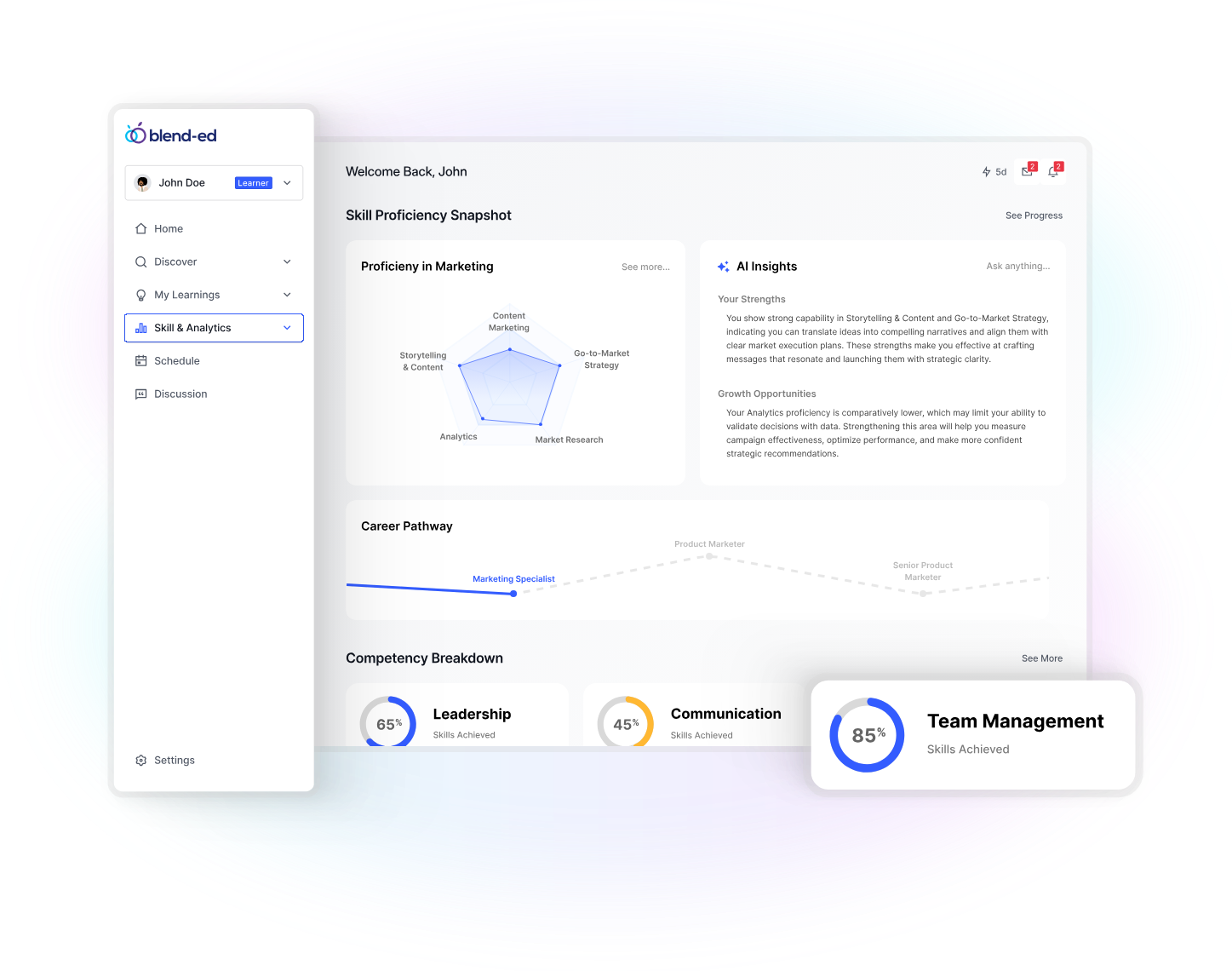
Blend-ed is an AI-native LMS built specifically for professional training companies and academies delivering structured certification programmes to external clients. It is not a corporate L&D tool adapted for training businesses. It is designed from the ground up for the commercial training model: multiple clients, multiple cohorts, blended delivery, and certification workflows that need to run without manual intervention at every step.
The platform combines course authoring, delivery, learner management, certification tracking, and built-in ecommerce in one system. Training companies use it to move away from disconnected tools like Zoom, spreadsheets, and manual certificate emails and into a single platform that handles the full learner journey from enrollment to certificate issuance.
Risknowlogy (Netherlands), one of the world's leading IEC 61508 and IEC 61511 training and certification providers, runs its full programme portfolio on Blend-ed.
Best For
- Functional safety training companies delivering IEC 61508, IEC 61511, ISO 26262, IEC 62443 programmes
- TUV SUD and TUV Rheinland approved course providers
- exida-affiliated training organisations
- IRCA approved training organisations running ISO lead auditor programmes
- Any training company managing multiple certification programmes for external clients
Key Strengths
- Purpose-built for training companies, not internal L&D teams
- Dual certificate issuance: issue both your company certificate and a TUV or exida certificate from a single learner record
- Multi-cohort management: run simultaneous cohorts of IEC 61508, IEC 61511, LOPA, and FSM programmes with separate learner sets and exam records
- Multi-client portals: separate branded environments per corporate client with separate reporting and data isolation
- AI Course Creator: convert a regulation document, standard clause, or SOP into a structured course with modules and assessments in hours
- AI Tutor: on-demand learner support that reduces the administrative load on your instructors between cohorts
- Certification expiry tracking with automated re-enrolment for recertification programmes
- Audit-ready reports: timestamped completion records, exam scores, and certificate logs exportable for TUV body programme audits
- Built on Open edX: the infrastructure behind MIT OpenCourseWare and Harvard Online Learning
Limitations
- No pre-built content library for functional safety standards (you bring your own course content or build it with the AI Course Creator)
- Initial setup for complex dual-certificate workflows may require an onboarding session with the Blend-ed team
Pricing Overview
Custom pricing based on monthly active users and required features. Contact blend-ed.com for a quote.
Verdict for Functional Safety Training Companies
The only platform in this comparison built specifically for training companies running certification programmes for external learners. If dual certificate issuance, IEC 61511 cohort management, and TUV audit-ready records are requirements, Blend-ed is the strongest fit.
2. Totara
Overview
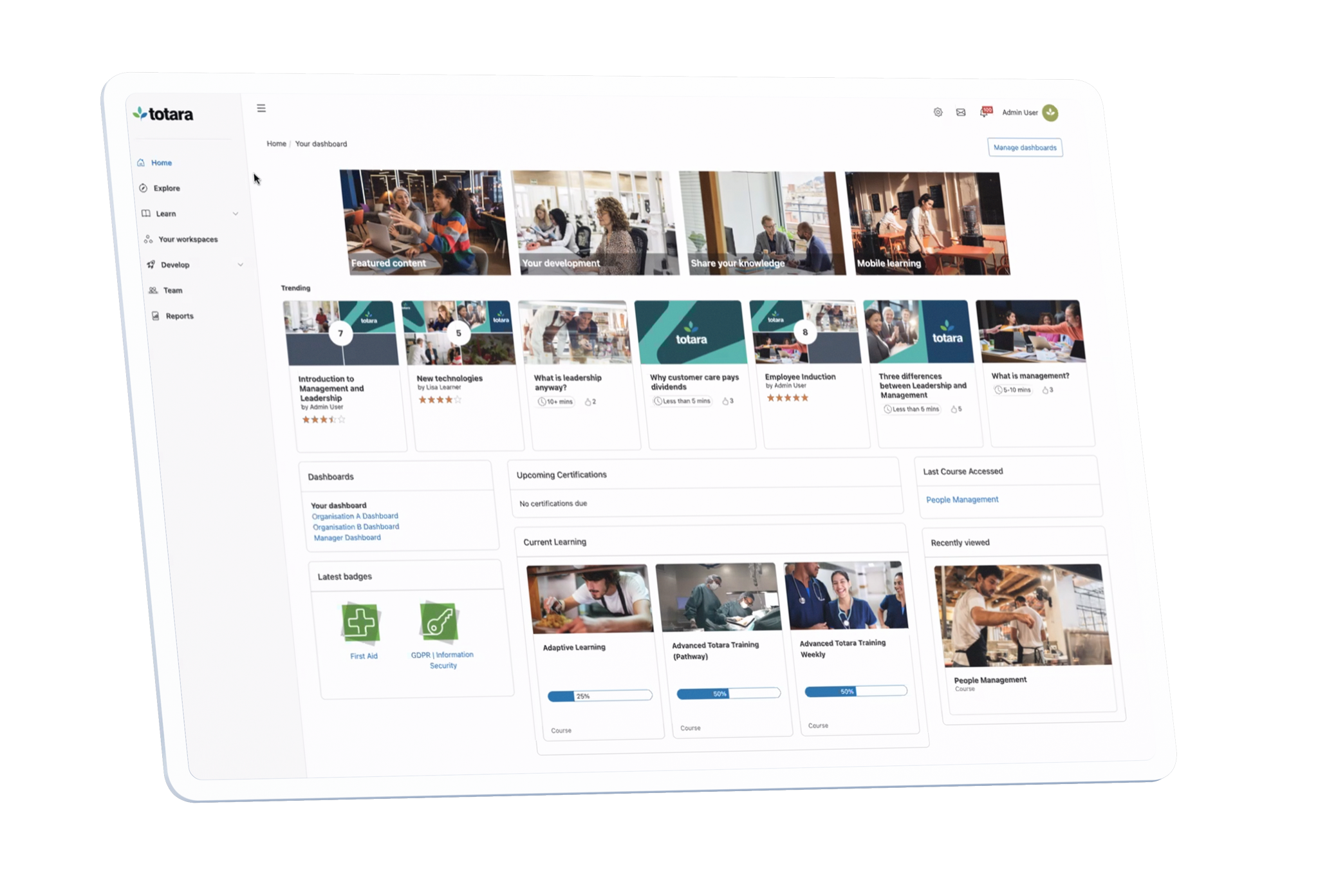
Totara is an open-source enterprise LMS with over 21 million users globally. It has strong multitenancy, compliance tracking, and certification pathway features. It is trusted by large organisations including USDA and NHS for internal compliance and mandatory training.
Best For
- Large enterprise organisations managing internal safety and compliance training
- Organisations with in-house IT teams that can configure and maintain an open-source platform
- Companies needing deep customisation of their learning environment
Key Strengths
- Robust certification pathways with expiry and renewal management
- Strong multi-tenancy: separate branded environments per department or client
- Highly configurable with a large partner and plugin ecosystem
- Good compliance reporting and audit trail capabilities
- Recognised as a Top 10 Enterprise LMS by Talented Learning (2025)
Limitations
- Not built for external training companies. Totara is designed for organisations training their own workforce, not training companies selling certification programmes to other organisations
- Dual certificate issuance for TUV-style programmes requires custom development
- The UX is reported as less modern than competing platforms, with a steeper admin learning curve
- No native AI course creation capability
- Implementation requires a Totara partner and significant configuration time
Pricing Overview
Subscription-based, delivered through a global partner network. Pricing varies by partner and deployment size.
Verdict for Functional Safety Training Companies
A strong compliance LMS for enterprises managing internal training. Not optimised for certification-driven training businesses selling programmes to external clients.
3. Moodle Workplace
Overview
Moodle Workplace is the commercial tier of Moodle, the world's most widely used open-source LMS. It adds multi-tenancy, certification management, and enterprise features on top of the free Moodle core. Many functional safety training companies start on standard Moodle. Moodle Workplace is the upgrade path for those that need managed multi-tenancy without full migration to a new platform.
Best For
- Functional safety training companies already running on Moodle who need multi-tenancy without switching platforms
- Organisations with existing Moodle content libraries they want to preserve
- Teams with in-house technical resource to configure and maintain the platform
Key Strengths
- Multi-tenancy with separate branding and reporting per client
- Large plugin ecosystem for extending functionality
- SCORM compliant: import existing course content without rebuilding
- Certification and programme management features at the Workplace tier
- Full data ownership and self-hosting option
Limitations
- Dual certificate issuance for TUV programmes is not a native feature and requires plugin development or custom builds
- Modern learner UX for high-paying certification learners (engineers paying EUR 2,000+ per course) requires theme investment
- Scaling to 10+ simultaneous cohorts with different client portals becomes administratively complex
- No AI course creation capability in core Moodle
- Customer support through community forums on open-source tier; paid support through partners on Workplace tier
Pricing Overview
Moodle open-source is free. Moodle Workplace is subscription-based through Moodle partners. Costs vary by partner and deployment.
Verdict for Functional Safety Training Companies
The most common starting point for functional safety training companies, and a reasonable one at low cohort volumes. Total cost of ownership rises sharply at scale when IT overhead and customisation work are included.
4. Absorb LMS
Overview
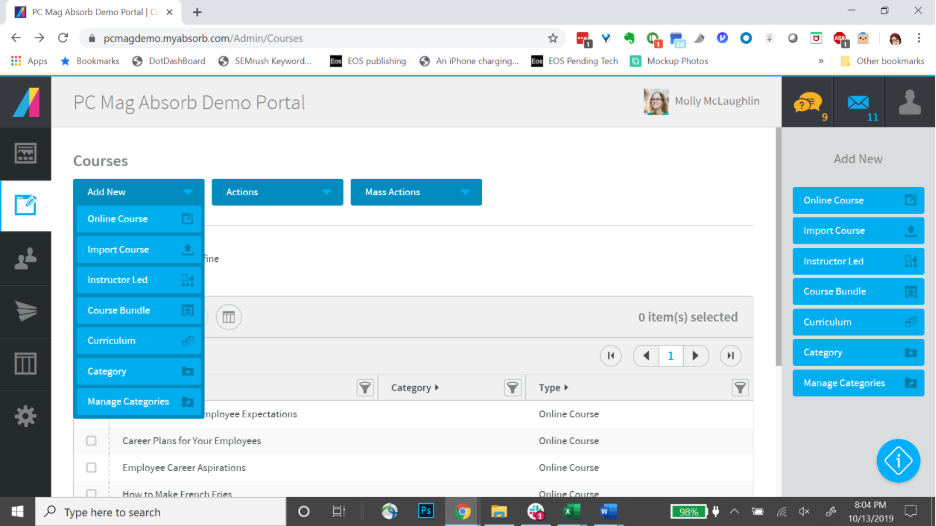
Absorb LMS is an AI-powered corporate LMS used by over 3,500 organisations. It handles employee training, customer education, and partner enablement well. It has ecommerce capabilities for selling courses externally and multi-tenancy for managing separate client groups.
Best For
- Corporate organisations managing internal safety compliance and onboarding training
- Companies that also sell training externally and need a single platform with ecommerce
- Mid-to-large enterprises with L&D teams managing high training volumes
Key Strengths
- Clean, modern UX that is widely praised by administrators and learners
- Certification tracking with automated reminders and renewal management
- eCommerce module for selling courses directly to external buyers
- Multi-tenancy with separate branded portals per department or client
- Strong compliance training capabilities for OSHA and regulatory frameworks
- AI tools for course creation (Absorb Create) and administrative tasks
Limitations
- Built for corporate L&D, not for training companies whose primary revenue comes from selling external certification programmes
- Dual certificate issuance for TUV or exida programmes is not a native workflow
- One reviewer notes: "it is very difficult for us that there is only one certificate expiration message for all courses, this is very problematic" for organisations with complex cert expiry requirements
- Pricing is custom-quoted and positions at the mid-to-upper range of enterprise LMS pricing (estimated at USD 8 to 16 per learner per month)
- Implementation timelines can stretch to 12 weeks or longer for enterprise deployments
Pricing Overview
Custom-quoted per learner. Estimated at USD 8 to 16 per learner per month based on third-party sources.
Verdict for Functional Safety Training Companies
An excellent corporate compliance LMS. Not designed for the dual-certificate, cohort-based, multi-programme workflows that IEC 61508 and IEC 61511 training companies require.
5. TalentLMS
Overview
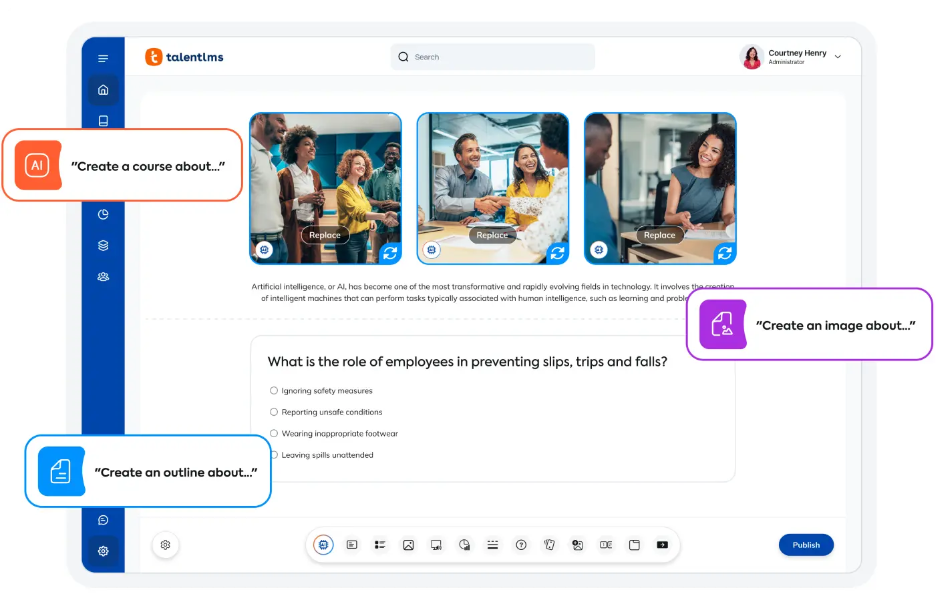
TalentLMS is a widely used, affordable cloud LMS designed for teams that need to get training running quickly. It is popular with small to mid-size businesses for onboarding, compliance training, and product training. It is easy to set up and has a clean interface.
Best For
- Small to mid-sized businesses running internal compliance and safety training
- Teams that need a quick-to-deploy LMS without complex certification requirements
- Organisations looking for an affordable platform with a short setup time
Key Strengths
- Very fast to set up and deploy, often live within days
- Affordable pricing with transparent per-user tiers
- Clean interface with good learner experience for self-paced content
- SCORM compliance for importing existing content
- Basic certification with expiry reminders
Limitations
- Not designed for training companies running certification programmes for external clients
- No multi-client portal architecture for separate corporate client management
- Dual certificate issuance for TUV or exida programmes is not supported
- No cohort-based delivery model for multi-day instructor-led programmes
- Limited assessment management for formal exam workflows
- No AI course creation capability
Pricing Overview
Transparent per-user pricing. Starts from USD 69 per month for up to 40 users. Business plans scale up from there.
Verdict for Functional Safety Training Companies
A good starting tool for simple internal training programmes. Missing the certification lifecycle, cohort management, and multi-client portal capabilities that functional safety training companies need as they scale.
6. Docebo
Overview
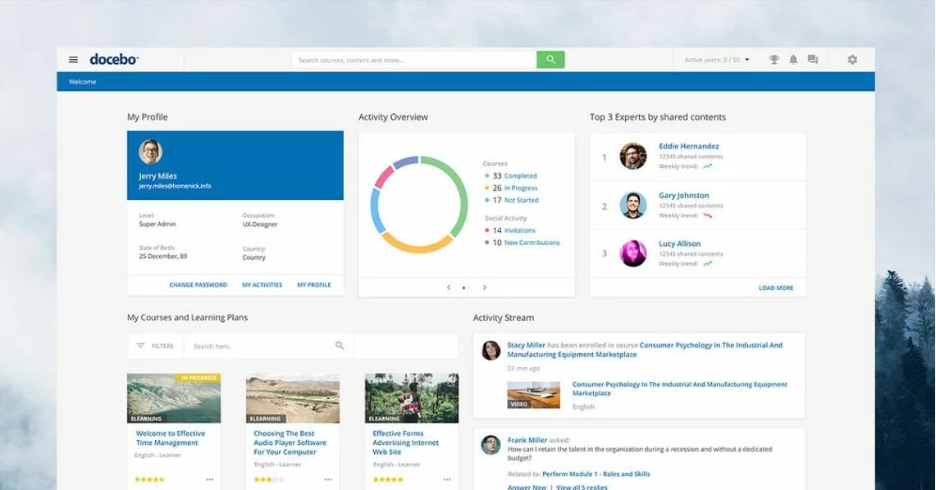
Docebo is an AI-powered enterprise LMS used by midsize and large organisations including Starbucks, Uber, and Thomson Reuters. It supports employee training, customer education, and partner enablement from a single platform. Unlike most corporate LMS platforms that focus purely on internal training, Docebo has extended enterprise capabilities that allow organisations to deliver training to multiple external audiences with separate branded portals. It is a polished, scalable platform with strong automation and a modern learner interface.
Best For
- Mid-to-large enterprises managing both internal and external training audiences
- Organisations that need a modern, well-designed learner experience at scale
- Companies managing partner and customer education alongside employee training
Key Strengths
- Extended enterprise architecture: separate branded portals for different external audiences from one platform
- Strong automation for enrollments, certification renewals, and learning pathway management
- Modern, intuitive UI praised consistently by both admins and learners
- AI-powered content recommendations and course creation (Docebo Creator)
- Robust reporting and learning analytics with good audit trail capabilities
- Broad integration ecosystem including Salesforce, Microsoft Teams, and Zoom
- Scales well for large learner volumes across multiple geographies and languages
Limitations
- Built primarily for corporate learning. The dual-certificate workflow required for TUV SUD or exida certified programmes is not a native feature
- No cohort-based delivery model designed for multi-day instructor-led professional certification programmes
- Primarily serves large enterprises. Smaller training companies with fewer than 200 learners often report feeling underserved
- Advanced features are locked behind higher-tier plans, making the total cost significant for specialist training businesses
- Implementation is complex. One reviewer notes: "if you need a lot of support, it may be better to go elsewhere"
- Pricing starts at an estimated USD 7 to 10 per learner per month, positioning it at the premium end of the market
Pricing
Custom-quoted. Estimated at USD 7 to 10 per learner per month based on third-party sources. Starter, Advanced, and Enterprise tiers available.
Verdict for Functional Safety Training Companies
A capable enterprise LMS with genuine extended enterprise features. Not designed for the certification lifecycle that IEC 61508, IEC 61511, and TUV training companies require. Functional safety training businesses evaluating Docebo will find it handles the delivery and reporting side competently but will need custom work to support dual certificate issuance and cohort-based programme management.
Comparison Table: Best LMS for Functional Safety Training Companies in 2026
| Feature | Blend-ed | Totara | Moodle Workplace | Absorb LMS | TalentLMS | Docebo |
|---|---|---|---|---|---|---|
| Built for external training companies | Yes | No | Partial | Partial | No | Partial |
| Multi-cohort management | Yes | Yes | Partial | Partial | No | Partial |
| Dual certificate issuance (TUV / exida) | Yes | Custom dev | Custom dev | No | No | No |
| Multi-client portals | Yes | Yes | Yes | Yes | No | Yes |
| Exam and pass/fail tracking | Yes | Yes | Yes | Yes | Basic | Yes |
| Certification expiry and re-enrolment | Yes | Yes | Partial | Partial | Basic | Yes |
| AI course creation | Yes | No | No | Partial | No | Partial |
| Audit-ready records for TUV reviews | Yes | Partial | Partial | Partial | No | Partial |
| LOPA / FSM programme management | Yes | Custom | Custom | No | No | No |
| Pricing model | Per MAU | Per user | Partner-quoted | Per learner | Per user | Custom |
Why Most LMS Platforms Fail Certification-Based Training Companies
There is a structural reason why corporate LMS platforms fail functional safety training businesses, and it comes down to who they were built for.
Corporate LMS platforms are built for an HR or L&D team whose job is to train their own employees. The learner is an employee. The training is mandatory. The certificate proves the employee completed a module. That certificate typically does not expire, or if it does, a simple reminder email is sufficient.
In functional safety training, the certificate is the product. An engineer pays EUR 2,500 to sit a 5-day IEC 61511 course because the TUV SUD FSCP certificate at the end is what their employer requires to deploy them on SIS projects. The training company's reputation depends on the quality of the exam, the validity of the certificate, and the professional credibility of the certification body behind it.
This is why platforms like TalentLMS and Absorb LMS, which are excellent at corporate compliance training, do not fit the functional safety training business model. It is not that they are bad platforms. It is that the use case they are optimised for is fundamentally different.
The platforms that come closest to functional safety training requirements are the ones designed for external certification training: platforms where the learner is a paying customer, the certificate is issued under a third-party certification body, and the training company needs to manage multiple programmes simultaneously for multiple corporate clients.
When Should a Functional Safety Training Company Upgrade to an LMS?
If you are running fewer than three cohorts per year and managing everything through email, spreadsheets, and Zoom, an LMS is probably not your most pressing investment. The operational overhead of managing a platform may exceed the time it saves.
The moment to invest in a purpose-built LMS is when one or more of these are true:
You are running four or more cohorts per year
At this volume, manual certificate tracking, learner communication, and exam record keeping consumes significant admin time. An LMS with automated workflows pays for itself.
You have more than one corporate client
Once you are managing learners from different companies with different reporting requirements, a multi-client portal architecture becomes necessary rather than optional.
A TUV body or IRCA audit is coming up
If you need to demonstrate a complete, timestamped learner record for every person who has taken your IEC 61508 or IEC 61511 course, you need a system that produces that evidence cleanly. Spreadsheets do not do this reliably.
You are expanding internationally
Running IEC 61511 cohorts across Netherlands, UK, Finland, and Houston simultaneously requires a platform built for multilingual, multi-timezone, multi-geography delivery.
A corporate client has asked for a compliance report
When a major oil and gas company asks for a report showing all of their engineers' certificate statuses across your programmes, you need a dashboard that produces that in minutes, not days.
How AI is Changing Functional Safety Training Delivery
AI is having a real impact on functional safety training companies in two specific areas.
Course creation speed
Updating an IEC 61508 course when a new edition of the standard is released used to take weeks of instructional design work. AI course creation tools can now take a document, a standard clause, or a set of lecture notes and generate a structured course with modules, knowledge checks, and assessments in hours. For training companies that run 5 to 10 distinct programmes, this significantly reduces the cost of keeping content current.
Learner support between sessions
IEC 61511 and LOPA courses are technically dense. Learners have questions between sessions about SIL calculations, PFD modelling, and SIS lifecycle documentation. An AI tutor trained on the course materials can answer these questions at any time without requiring the instructor to respond to emails at midnight before a cohort week.
What AI cannot replace is the domain expertise of a functional safety instructor with real SIS project experience. The credibility of a TUV SUD certificate depends on the quality of the exam and the rigour of the programme. AI supports the operational infrastructure around that. It does not replace the substance.
How to Choose the Right LMS for Your Functional Safety Training Business
The right LMS depends on where your training business is today and what your most pressing operational constraint is.
If you are bootstrapping and running 1 to 3 cohorts per year: Moodle Workplace covers multi-tenancy at low cost, but budget for custom TUV certificate workflows when you scale.
If you are running TUV SUD or TUV Rheinland certified programmes: You need dual certificate issuance as a native feature, not a custom build. Blend-ed is the realistic option here.
If you are a large enterprise training engineers internally: Docebo and Totara are solid for internal compliance delivery, but neither is designed for selling certified programmes to external clients.
If you need a quick, affordable platform for simple internal safety training: TalentLMS deploys fast and is easy to manage. It works well for straightforward internal programmes but lacks the cohort management and certification workflows that external training businesses need.
If you want a polished corporate LMS with ecommerce for external training: Absorb LMS handles external learner delivery and has certification tracking built in. It is a strong option for organisations selling training externally, though TUV dual-certificate workflows require custom configuration.
If you are scaling internationally across Netherlands, UK, Germany, and Houston: You need multilingual delivery, multi-timezone cohort management, and infrastructure that meets data residency requirements. Blend-ed is built for this from the ground up.
Frequently Asked Questions About LMS for Functional Safety Training Companies
What is the best LMS for functional safety training companies in 2026?
Blend-ed is the strongest fit for companies needing dual certificate issuance, multi-cohort management, and TUV audit-ready records. It is the only platform in this comparison purpose-built for training companies delivering certified programmes to external learners. For internal enterprise training, Docebo and Totara are competent options. For companies already on Moodle, Moodle Workplace is the most practical upgrade path.
What does an LMS for IEC 61511 training need to support?
It needs cohort-based delivery for structured 3 to 5 day programmes, formal examination management with pass/fail thresholds, dual certificate issuance linking the training company certificate to the TUV SUD FSCP or ISA/IEC 61511 Specialist certificate, multi-client portals for corporate clients, and audit-ready records for Functional Safety Management system audits. IEC 61511 requires companies to demonstrate personnel competence. The LMS evidence trail is part of that proof.
Can Moodle Workplace handle TUV certification training at scale?
Moodle Workplace solves multi-tenancy but dual certificate issuance for TUV programmes still requires custom development. Cohort-based exam management needs additional configuration. At low to medium cohort volumes it is a workable choice for teams already in the Moodle ecosystem. At higher volumes the total cost of ownership including customisation and maintenance typically exceeds purpose-built alternatives.
What is dual certificate issuance and why does it matter for TUV programmes?
Dual certificate issuance means issuing two separate certificates from one learner record: one from the training company and one from TUV SUD, TUV Rheinland, or exida. Each has different issuance criteria, templates, and audit trail requirements. Generic platforms like Docebo, Absorb LMS, and TalentLMS require custom development to support this. Blend-ed handles it natively.
Ready to see how Blend-ed handles IEC 61508 and IEC 61511 certification delivery? Book a 30-minute demo. We will show you everything live. Book a Demo