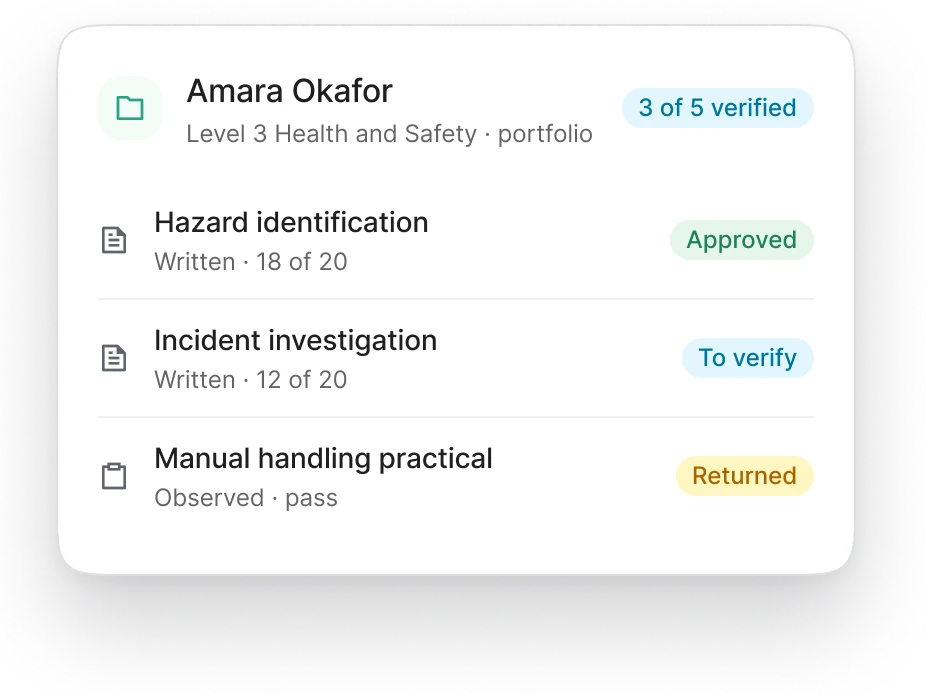
Keep each learner's assessment evidence together, as a portfolio.
Submissions, files, marks, sign-offs and observations sit on one record for each learner, for your assessors, your internal verifier and your awarding body.

Questions about portfolios.
Everything they handed in for assessment: written answers and uploaded files, each with its rubric marks, feedback and sign-off. Practical observations and attendance for each day. Verification decisions. Every attempt, not only the last one.
Yes. An assignment can ask for files instead of a written answer, or as well as one: documents, photos or other files from their work. Each file is marked against the rubric like any other submission.
Tag each assignment and question with the skills it assesses. When a learner's work on it is graded, the skill is recorded on their skill passport, so the evidence and the skill sit together. Skill tagging →
The learner, the trainers and assessors on their course, the internal verifier, your team, and an auditor with read-only access. Auditor access →
Export it: every learner's answers to one question in one file, grade reports, attendance registers and certificate records. Evidence exports →
It stays. When a cohort closes, learners still see their work but can't submit anything new, and training records stay in Blend‑ed for as long as you use it. Records retention →
Related.
Part of Assessments and grading
Assignments and open-response assessments: where written work and files are handed in.
Internal verification and moderation: the second check on marked work.

Bring the evidence list your awarding body asks for.
We'll show you where each item sits in a learner's portfolio in Blend‑ed.